Ball clay is an important industrial clay widely used in India, especially in the ceramics and manufacturing sectors. It is valued for its high plasticity, fine particle size, and strong binding properties. These characteristics make ball clay a key raw material in ceramic products such as tiles, sanitary ware, pottery, and porcelain.
India has rich deposits of ball clay and a strong manufacturing base that supplies both domestic and international markets. This detailed guide explains what ball clay is, its properties, uses, benefits, grades, chemical composition, price, and the role of ball clay suppliers and manufacturers in India.
What is Ball Clay
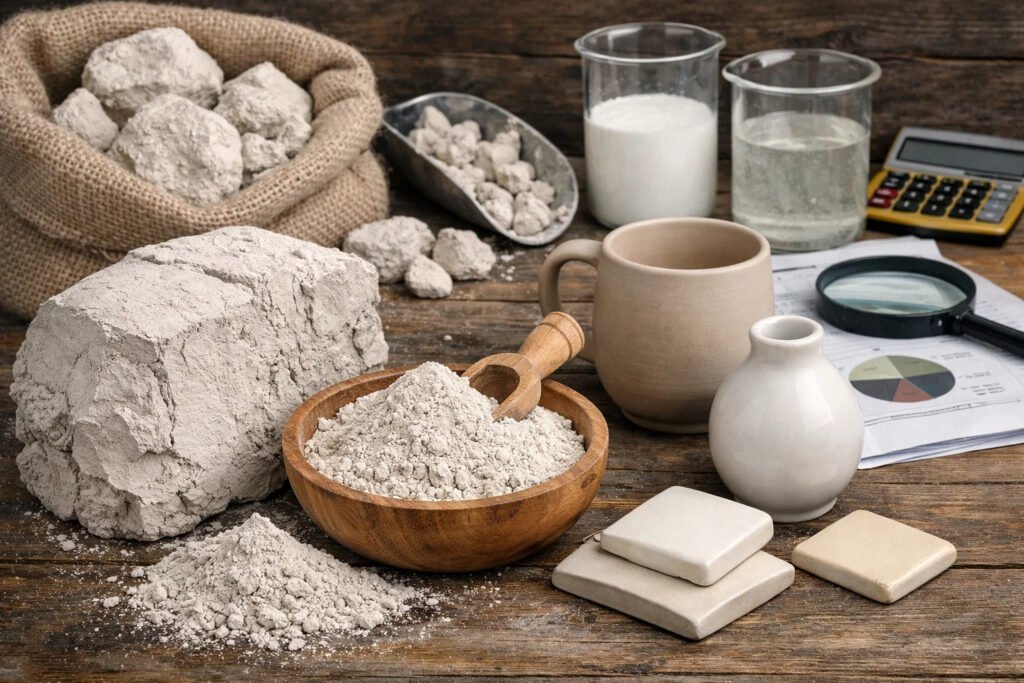
Ball clay is a naturally occurring fine-grained clay formed through the weathering of rocks and sedimentary processes over long periods. It is typically found in river basins and sedimentary deposits. The name “ball clay” comes from the traditional method of cutting the clay into cube-like blocks and shaping them into balls for transportation.
Ball clay belongs to the kaolinite group of clays but differs from pure kaolin due to its higher plasticity and finer particle size. These qualities allow it to be easily shaped and molded when mixed with water. Ball clay is rarely used alone and is usually blended with other clays to improve strength, flexibility, and workability.
In India, ball clay is mainly used in ceramic manufacturing hubs where consistent quality and performance are essential.
Ball Clay Chemical Composition
Ball clay chemical composition varies depending on the deposit, but it generally contains a mixture of clay minerals and other components that influence its performance.
The main components include:
- Kaolinite
- Quartz
- Mica
- Organic matter
- Minor trace minerals
Ball clay has a balanced combination of silica and alumina. Silica contributes to strength and thermal stability, while alumina improves hardness and durability after firing. Organic matter present in ball clay improves plasticity and helps the clay remain workable during shaping.
Small amounts of iron oxide and other impurities may also be present. These affect the fired color and suitability for specific ceramic products, especially white-bodied ceramics.
Ball Clay Properties
Ball clay properties are the reason it is widely used in ceramics and industrial applications across India. The most important properties include:
- High plasticity
- Very fine particle size
- Strong bonding ability
- Good workability
- High drying strength
- High fired strength
- Low shrinkage when fired
- Smooth surface texture
These properties help manufacturers achieve better shape retention, reduce cracking during drying, and improve the overall quality of finished products. Ball clay also enhances the flexibility of ceramic bodies, allowing complex shapes and thin sections to be formed.
Ball Clay Uses
Ball clay uses are mainly concentrated in the ceramics industry, but its application extends to several other sectors as well.
Ceramics, Tiles, and Sanitary Ware
The largest use of ball clay in India is in ceramic manufacturing. Ball clay is added to ceramic bodies to improve plasticity and strength. It helps in shaping tiles, sanitary ware, tableware, and decorative ceramic items.
Ball clay reduces cracking during drying and firing and improves surface smoothness. In tile and sanitary ware production, it ensures consistent quality and dimensional stability.
Porcelain and Pottery
Ball clay is widely used in porcelain and pottery products. It improves workability and allows finer detailing during shaping. Ball clay also supports high-temperature firing, which is essential for porcelain products.
Refractory and Heat-Resistant Products
In some applications, ball clay is used in refractory products because of its bonding properties and thermal stability. It helps maintain strength at elevated temperatures.
Rubber and Plastic Industry
Ball clay is used as a filler in rubber and plastic products. It improves durability, stiffness, and surface finish while also helping to reduce production costs.
Paints and Coatings
In paints and coatings, ball clay acts as a functional filler. It improves consistency, texture, and coverage and supports uniform application.
Paper Industry
Ball clay is used as a coating and filler material in paper manufacturing. It improves brightness, smoothness, and print quality, making it suitable for high-quality paper products.
Other Industrial Applications
Ball clay is also used in drilling mud, adhesives, sealants, and ceramic components for electrical and industrial applications.
Ball Clay Benefits
Ball clay offers several benefits to manufacturers and industrial users in India.
Key ball clay benefits include:
- Improved plasticity and shaping ability
- Better bonding and strength
- Reduced cracking during drying
- Improved fired strength
- Smooth surface finish
- Better consistency in production
- Cost-effective raw material
These benefits make ball clay an essential component in ceramic bodies and other industrial formulations.
Ball Clay Grades
Ball clay grades are classified based on particle size, plasticity, organic content, and impurity levels. The selection of the right grade depends on the intended application.
Fine Grade Ball Clay
Fine grade ball clay has very small particles and high plasticity. It is mainly used in porcelain, fine ceramics, and white-bodied ceramic products.
Medium Grade Ball Clay
Medium grade ball clay is commonly used in tiles and sanitary ware. It offers a balance between plasticity, strength, and cost.
Coarse Grade Ball Clay
Coarse grade ball clay has relatively larger particles and is used in industrial and construction-related applications where extreme plasticity is not required.
Manufacturers often test different grades to achieve the best performance for specific products.
Ball Clay Price in India
Ball clay price in India depends on several factors such as grade, purity, location, and demand. High plasticity and fine-grade ball clay generally cost more due to better performance and lower impurity levels.
Transportation costs, mining location, and order quantity also influence pricing. Bulk buyers often receive better pricing based on long-term supply agreements.
For accurate and current ball clay prices, it is recommended to contact suppliers directly and request quotations based on the required grade and volume.
Ball Clay Suppliers and Manufacturers in India
India has a strong network of ball clay suppliers and manufacturers supporting the ceramics and industrial sectors. Major production areas are located in states such as Rajasthan, Gujarat, Tamil Nadu, Andhra Pradesh, and Kerala.
Role of Suppliers
Ball clay suppliers focus on sourcing, grading, and delivering clay to ceramic and industrial customers. They ensure consistency, timely delivery, and availability of different grades.
Role of Manufacturers
Ball clay manufacturers process raw clay through washing, drying, grinding, and grading. Quality control is a key part of the process to ensure uniform properties and reliable performance.
How to Choose the Right Supplier or Manufacturer
When selecting ball clay suppliers or manufacturers in India, consider:
- Quality consistency
- Available grades
- Processing capability
- Supply capacity
- Pricing transparency
- Technical support
Choosing a reliable supplier ensures stable production and consistent product quality.
Conclusion
Ball clay is a vital industrial clay that plays a major role in India’s ceramics and manufacturing industries. Its high plasticity, fine particle size, and strong bonding properties make it essential for tiles, sanitary ware, pottery, and porcelain production.
Understanding what ball clay is, along with its properties, uses, benefits, grades, price, and supply chain in India, helps buyers and manufacturers make informed decisions. Selecting the right grade and working with dependable suppliers and manufacturers ensures consistent quality and long-term success.
Frequently Ask Questions
Ball clay is mainly used in ceramics, tiles, sanitary ware, porcelain, and other industrial applications to improve plasticity and strength.
Ball clay has high plasticity, fine particle size, strong bonding ability, and good fired strength.
Ball clay mainly contains kaolinite, quartz, mica, and organic matter, along with small amounts of other minerals.
Ball clay grades are classified as fine, medium, and coarse based on particle size and plasticity.
Ball clay price depends on grade, purity, location, and order quantity. Higher grade clay generally costs more.
Ball clay deposits are found in states such as Rajasthan, Gujarat, Tamil Nadu, Andhra Pradesh, and Kerala.