

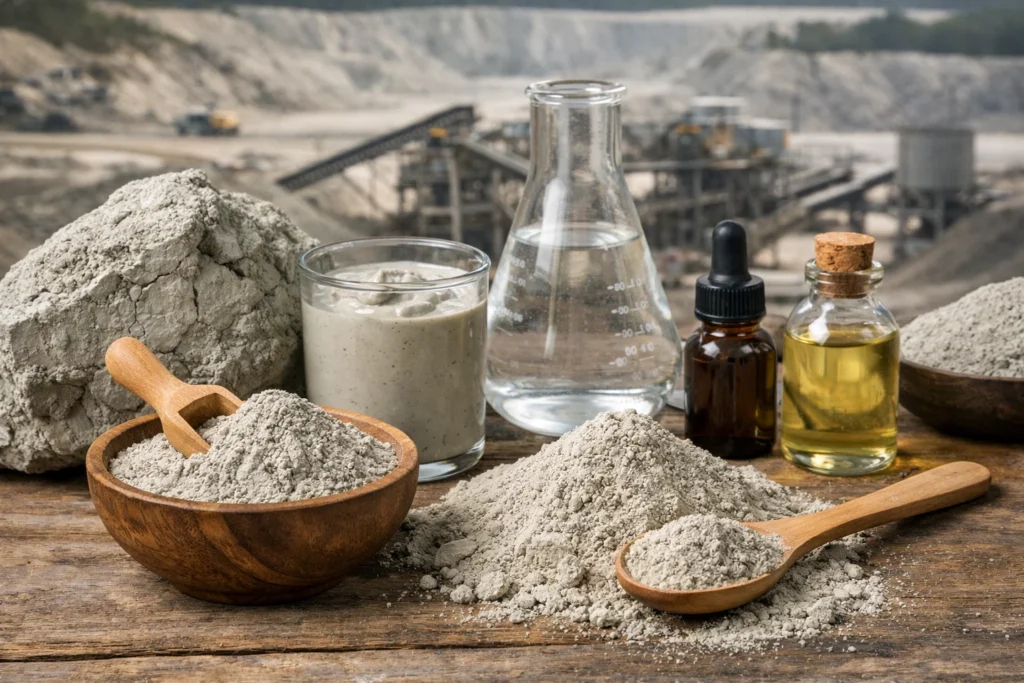
Bentonite clay is one of the most widely used industrial minerals due to its unique physical and chemical properties. Known for its high swelling capacity, strong absorption ability, and natural binding characteristics, bentonite plays a crucial role in many industrial applications. Industries such as drilling, foundry, construction, water treatment, and manufacturing rely on bentonite clay for improving material performance and process efficiency.
This naturally occurring clay mineral is formed from volcanic ash deposits that have undergone chemical transformation over millions of years. The resulting mineral structure provides bentonite with exceptional properties that make it valuable for industrial processing and material formulations.
Understanding the composition, types, properties, and industrial uses of bentonite clay helps manufacturers and industrial buyers select the appropriate material for their specific applications.
What Is Bentonite Clay
Bentonite clay is a natural clay mineral primarily composed of the mineral montmorillonite, which belongs to the smectite group of minerals. It forms through the alteration of volcanic ash in the presence of water over long geological periods.
The structure of bentonite clay allows it to absorb large amounts of water and expand significantly. This swelling property is one of the defining characteristics that makes bentonite useful for industrial applications.
The clay typically appears as a soft, fine-grained material that can vary in color depending on the mineral composition and deposit location. Bentonite deposits are found in various parts of the world and are mined for industrial processing.
Because of its unique mineral structure, bentonite clay is widely used in applications that require absorption, sealing, binding, and suspension properties.
Composition and Mineral Structure of Bentonite Clay
The main component of bentonite clay is montmorillonite, a layered silicate mineral that gives the clay its characteristic swelling behavior. The layered structure allows water molecules to enter between the mineral sheets, causing the clay to expand.
The chemical composition of bentonite typically includes:
• Silicon dioxide
• Aluminum oxide
• Iron oxide
• Magnesium oxide
• Calcium oxide
• Sodium oxide
The exact composition may vary depending on the source of the deposit and the geological conditions under which the clay was formed.
This mineral composition provides bentonite with important industrial characteristics such as high cation exchange capacity, adsorption ability, and strong binding properties.
Types of Bentonite Clay
Bentonite clay is generally classified into different types based on the dominant exchangeable cation present in the clay structure. The two main types used in industrial applications are sodium bentonite and calcium bentonite.
Sodium Bentonite
Sodium bentonite is known for its high swelling capacity and strong water absorption properties. When it comes into contact with water, it can expand several times its original volume.
Key characteristics include:
• High swelling ability
• Strong sealing properties
• Excellent suspension capability
• High viscosity when mixed with water
Because of these properties, sodium bentonite is commonly used in drilling fluids, sealing applications, and environmental containment systems.
Calcium Bentonite
Calcium bentonite has lower swelling capacity compared to sodium bentonite but still offers useful absorption and binding properties.
Key characteristics include:
• Moderate swelling capacity
• Good adsorption capability
• Stable mineral structure
• Suitable for several industrial uses
Calcium bentonite is often used in applications such as absorbents, filtration systems, and certain industrial processing operations.
Modified and Activated Bentonite
In addition to natural bentonite types, modified or activated bentonite may be produced through chemical or thermal treatment. These processes improve specific properties of the clay for specialized industrial applications.
Activated bentonite is commonly used in purification processes, filtration systems, and chemical processing.
Physical and Chemical Properties of Bentonite Clay
Bentonite clay possesses several physical and chemical properties that make it valuable in industrial applications.
Swelling Capacity
One of the most important characteristics of bentonite clay is its ability to absorb water and expand. This swelling property makes it useful for sealing, drilling, and containment applications.
Absorption Ability
Bentonite can absorb large quantities of liquids and dissolved substances. This property allows the clay to be used in filtration systems, purification processes, and environmental applications.
Plasticity
Bentonite clay has strong plasticity when mixed with water. This property helps it function as a binding material in industrial mixtures and molded materials.
Binding Capability
The clay acts as a natural binder that helps hold other materials together in manufacturing processes such as foundry mold preparation and pelletizing operations.
Thermal Stability
Bentonite can maintain its structure and performance under high-temperature conditions, making it suitable for certain industrial processes.
Industrial Uses of Bentonite Clay
Bentonite clay is used across multiple industries because of its ability to absorb liquids, bind materials, and form stable suspensions.
Foundry Industry
In the foundry industry, bentonite clay is used as a binder in molding sand for metal casting processes. It helps maintain mold shape and stability during casting operations.
The clay binds sand particles together and provides the necessary strength for producing accurate casting molds.
Drilling and Oilfield Applications
Bentonite plays an important role in drilling operations. It is used in drilling fluids, commonly referred to as drilling mud, which helps stabilize boreholes and remove drilling cuttings from the well.
Drilling mud prepared with bentonite improves lubrication, controls pressure, and maintains well integrity during drilling operations.
Construction and Civil Engineering
Bentonite is widely used in construction and civil engineering projects due to its sealing and waterproofing properties.
Common applications include:
• Foundation waterproofing
• Slurry wall construction
• Soil stabilization
• Tunnel and underground construction
The swelling ability of bentonite helps prevent water penetration in structural systems.
Environmental Applications
Bentonite clay is used in environmental protection systems such as landfill liners and waste containment barriers. Its low permeability helps prevent the movement of contaminants into surrounding soil and groundwater.
Environmental engineering projects use bentonite to create protective layers that isolate hazardous materials.
Water Treatment and Filtration
The adsorption properties of bentonite allow it to remove certain impurities from liquids. In water treatment systems, bentonite may be used as a filtration aid or purification material.
This capability makes the clay useful in industrial water treatment processes.
Ceramic and Manufacturing Applications
In manufacturing industries, bentonite may be used as a binding material in various formulations. It helps improve mixture stability and processing performance in industrial production.
Advantages of Bentonite Clay in Industrial Applications
Bentonite clay offers several advantages that contribute to its widespread industrial use.
Key advantages include:
• High water absorption capacity
• Strong natural binding properties
• Effective sealing capability
• Chemical stability in many environments
• Cost-effective mineral resource
These characteristics make bentonite a reliable material for many industrial processes.
Processing of Bentonite Clay
Before bentonite clay can be used in industrial applications, it typically undergoes several processing steps.
The general processing stages include:
• Mining of bentonite deposits
• Drying to reduce moisture content
• Crushing and grinding
• Screening and particle size classification
• Packaging for industrial distribution
Processing ensures that the bentonite meets the required quality standards for industrial use.
Global Demand for Bentonite Clay
The demand for bentonite clay continues to grow due to its importance in industries such as drilling, construction, metal casting, and environmental engineering.
Increasing industrial development and infrastructure projects contribute to the growing use of bentonite worldwide. As industries expand, the need for reliable mineral resources such as bentonite clay continues to increase.
How to Choose the Right Bentonite Clay for Industrial Applications
Selecting the appropriate bentonite clay depends on several factors related to the intended application.
Important considerations include:
• Swelling capacity
• Mineral purity
• Particle size distribution
• Absorption characteristics
• Industrial performance requirements
Understanding these parameters helps manufacturers choose bentonite that meets the technical specifications required for their production processes.
Businesses that require reliable mineral materials for industrial applications should work with experienced suppliers who understand quality and performance requirements. Companies looking for consistent material supply can explore solutions from a trusted Bentonite Clay Supplier to support manufacturing and processing needs.
Conclusion
Bentonite clay is a highly versatile industrial mineral with a wide range of applications across multiple industries. Its unique properties such as swelling capacity, absorption ability, and natural binding strength make it valuable for manufacturing, construction, drilling, and environmental protection.
By understanding the composition, types, properties, and industrial uses of bentonite clay, manufacturers and industrial buyers can better select materials that support efficient production processes. As global industrial activity continues to grow, bentonite clay will remain an essential resource for many sectors that depend on reliable mineral materials.
FAQs
- What is bentonite clay used for
- Bentonite clay is used in industries such as drilling, construction, metal casting, water treatment, and environmental protection due to its absorption and sealing properties.
- What makes bentonite clay unique
- Bentonite clay is known for its ability to absorb water and expand, which gives it strong sealing and binding capabilities in industrial applications.
- What are the main types of bentonite clay
- The two main types are sodium bentonite and calcium bentonite, which differ mainly in swelling capacity and industrial uses.
- Which industries commonly use bentonite clay
- Industries such as oil and gas drilling, foundry manufacturing, construction, environmental engineering, and water treatment use bentonite clay.
- Why is bentonite used in drilling fluids
- Bentonite helps stabilize boreholes, remove drill cuttings, and maintain proper pressure conditions during drilling operations.