

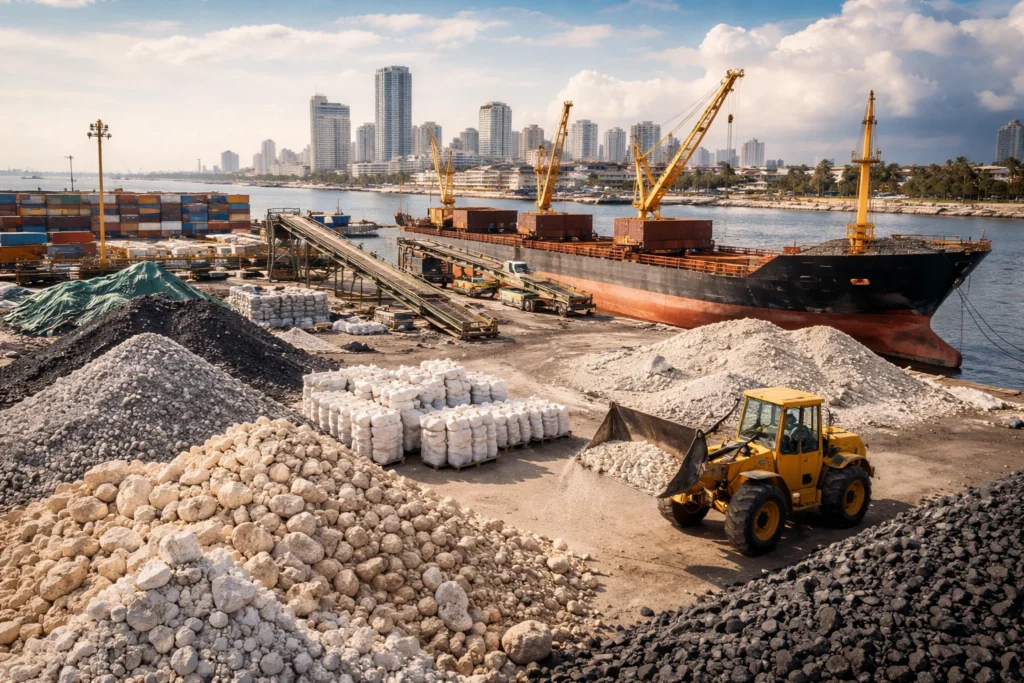
The industrial sector in the Philippines continues to expand across construction, ceramics, glass manufacturing, infrastructure, and foundry operations. As production standards increase, manufacturers require consistent, high-quality raw materials to maintain output efficiency and product quality.
Understanding how to import industrial minerals in Philippines is essential for procurement managers, distributors, and factory owners seeking a reliable bulk supply from international exporters.
This guide explains the full import process, documentation requirements, supplier evaluation factors, and cost considerations for industrial buyers.
Why Philippine Industries Import Industrial Minerals
Although the Philippines has domestic mineral resources, many industrial buyers import materials due to:
- Higher purity requirements
- Controlled particle size distribution
- Bulk volume demand
- Long-term supply reliability
- Specialized industrial-grade processing
For this reason, many manufacturers source industrial minerals for Philippine industries from experienced international exporters with advanced processing and export capabilities.
Key Industrial Minerals Imported into the Philippines
Several minerals play a critical role in the Philippine manufacturing sectors:
Silica Sand
High-purity silica sand is widely used in glass production, construction materials, and industrial casting processes.
Feldspar
Feldspar functions as a fluxing agent in ceramic and tile manufacturing, helping reduce melting temperature and improve product strength.
Kaolin Clay
Kaolin clay is used in ceramics, sanitaryware, and paper coating industries due to its whiteness and fine particle size.
Bentonite Clay
Bentonite clay is commonly applied in drilling fluids, foundry molds, and sealing applications because of its swelling and binding properties.
Ball Clay
Ball clay is preferred in ceramic formulations for its high plasticity and workability during shaping and molding processes.
Step-by-Step Process to Import Industrial Minerals in Philippines
1. Define Technical Specifications Clearly
Before contacting an exporter, buyers must determine:
- Required chemical composition
- Particle size distribution
- Moisture limits
- Application use
- Monthly or annual volume
Clear specifications reduce supply risks and ensure compatibility with production systems.
2. Evaluate and Select a Reliable Exporter
Choosing the right supplier is critical for long-term stability. A professional industrial mineral exporter should provide:
- Consistent quality control systems
- Laboratory test reports
- Export documentation support
- Bulk production capability
- Experience in international shipping
Many Philippine buyers work with exporters from India due to structured processing facilities and competitive bulk pricing advantages.
3. Prepare Import Documentation
To import industrial minerals into the Philippines, buyers typically require:
- Commercial Invoice
- Packing List
- Bill of Lading
- Certificate of Origin
- Quality Test Reports
- Required import permits (if applicable)
Working with a licensed customs broker simplifies regulatory compliance and clearance procedures.
4. Select Appropriate Shipping Method
Industrial minerals can be transported through:
- Bulk vessel shipments (cost-effective for large volumes)
- Containerized jumbo bags (ideal for controlled distribution)
Bulk shipment often reduces per-ton logistics costs for high-volume manufacturers.
5. Calculate Total Landed Cost
A proper import decision should consider:
- Product price
- Ocean freight
- Marine insurance
- Customs duties
- Port handling charges
- Inland transportation costs
Evaluating total landed cost ensures accurate supplier comparison and financial planning.
Building a Long-Term Supply Strategy
Rather than focusing on single transactions, industrial buyers should develop structured sourcing strategies that include:
- Long-term supply agreements
- Fixed pricing frameworks (where possible)
- Regular quality audits
- Clear communication channels
Stable supplier relationships help reduce procurement risk and improve operational efficiency.
Conclusion
Importing industrial minerals in Philippines requires technical clarity, supplier evaluation, regulatory compliance, and efficient logistics coordination. Manufacturers who establish partnerships with experienced exporters can secure consistent quality, competitive pricing, and reliable bulk supply.
A structured import strategy supports long-term industrial growth and operational stability in a competitive manufacturing environment.
FAQs
Q1. What documents are needed to import industrial minerals into the Philippines?
A1. Importers generally require a commercial invoice, packing list, bill of lading, certificate of origin, and relevant permits depending on mineral type.
Q2. Why do Philippine manufacturers import industrial minerals?
A2. They import to ensure consistent quality, meet high purity requirements, and secure bulk supply for continuous production.
Q3. What is the most cost-effective shipping method?
A3. Bulk vessel shipment is typically more economical for high-volume industrial imports.
Q4. How can buyers ensure consistent mineral quality?
A4. Buyers should request laboratory reports, approve samples before bulk orders, and work with experienced exporters.