

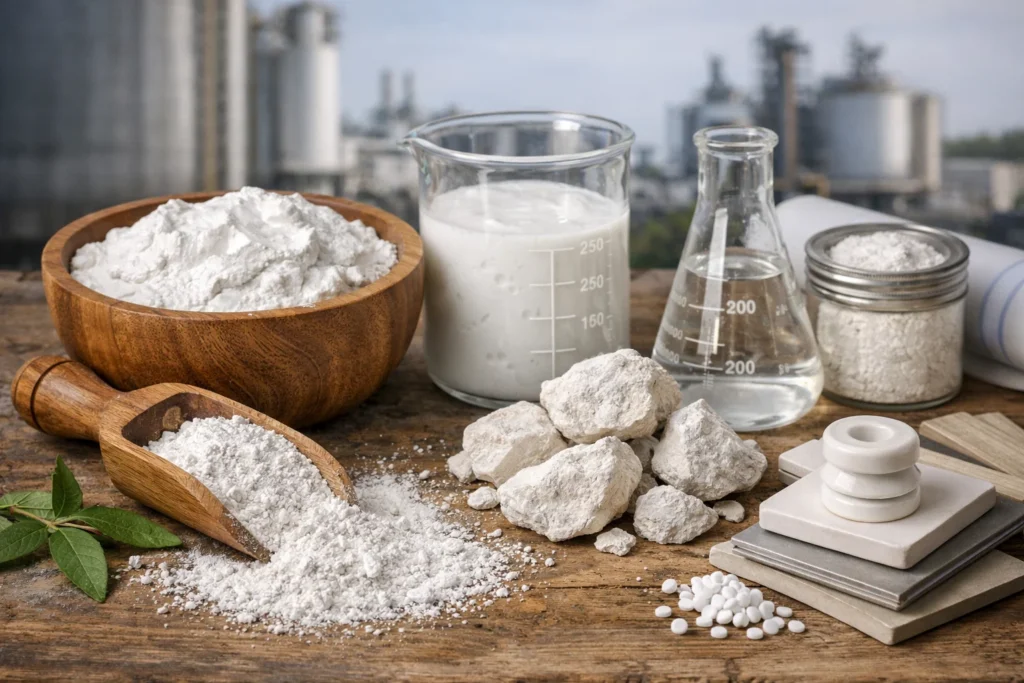
Hydrous kaolin is one of the most widely used industrial minerals across manufacturing sectors. Known for its fine particle size, high whiteness, and excellent chemical stability, this clay mineral plays an essential role in ceramics, paper production, paints, rubber, plastics, and many other industries.
Manufacturers prefer hydrous kaolin because it improves product performance, enhances surface finish and provides functional benefits in several industrial processes. Its natural mineral structure and high purity make it suitable for applications where consistency and quality are critical.
In this guide, we explore what hydrous kaolin is, its properties, benefits, and how different industries use it in modern manufacturing.
What is hydrous kaolin?
Hydrous kaolin is a naturally occurring clay mineral primarily composed of the mineral kaolinite. It forms through the weathering of feldspar-rich rocks over long geological periods.
Unlike calcined kaolin, hydrous kaolin retains its natural crystal structure and contains chemically bound water molecules. This gives it unique physical characteristics such as plasticity, softness and fine particle distribution.
Because of these properties, hydrous kaolin is widely used in industries that require smooth texture, high brightness, and controlled particle size.
Hydrous kaolin is typically processed through washing, filtration, and classification to remove impurities and produce consistent grades suitable for industrial use.
Key Properties of Hydrous Kaolin
The performance of hydrous kaolin in industrial applications is largely determined by its physical and chemical properties.
Important properties include:
• Fine particle size distribution
• High brightness and whiteness
• Excellent chemical stability
• Low abrasive characteristics
• Good plasticity for shaping processes
• High purity with minimal impurities
• Smooth texture and softness
These properties allow hydrous kaolin to perform multiple functional roles such as filler, coating material, reinforcing agent, and performance enhancer in various industries.
Industrial Applications of Hydrous Kaolin
Hydrous kaolin is used across many industrial sectors because it improves both product quality and manufacturing efficiency.
Ceramics Industry
The ceramics industry is one of the largest consumers of hydrous kaolin. It acts as a key raw material in the production of ceramic bodies and glazes.
In ceramic manufacturing, hydrous kaolin provides:
• Plasticity for shaping ceramic products
• Improved strength during drying
• Smooth surface finish after firing
• Enhanced whiteness and brightness
These properties make it valuable for producing tiles, sanitaryware, tableware, and technical ceramics.
Paper Industry
In the paper industry, hydrous kaolin is widely used as both a coating pigment and filler.
Its fine particle size and brightness improve paper quality by:
• Enhancing surface smoothness
• Increasing brightness and opacity
• Improving printability
• Reducing ink absorption
These advantages help manufacturers produce high-quality printing and writing papers.
Paint and Coatings Industry
Hydrous kaolin plays an important role in paint formulations. It functions as a functional filler and helps improve several performance characteristics.
Key benefits in paints include:
• Better suspension of pigments
• Improved coating uniformity
• Enhanced opacity and coverage
• Reduced formulation cost
Because of its chemical stability and particle size control, hydrous kaolin is widely used in architectural and industrial coatings.
Rubber Industry
In rubber manufacturing, hydrous kaolin is used as a reinforcing filler that improves the mechanical properties of rubber products.
It contributes to:
• Increased tensile strength
• Better durability and wear resistance
• Improved dimensional stability
• Enhanced processing performance
These benefits make hydrous kaolin suitable for rubber goods such as seals, hoses and molded products.
Plastics Industry
Hydrous kaolin is also used as a filler material in plastic compounds. It improves the performance and processing characteristics of plastic products.
Advantages in plastics include:
• Improved stiffness and rigidity
• Better dimensional stability
• Enhanced surface finish
• Reduced production costs
It is commonly used in packaging materials, household plastics and construction components.
Benefits of Using Hydrous Kaolin in Manufacturing
Hydrous kaolin provides several advantages that make it a preferred mineral in industrial production.
Key benefits include:
• Enhances product brightness and appearance
• Improves mechanical strength in composite materials
• Provides better surface smoothness in coatings
• Helps control viscosity and rheology in formulations
• Reduces production costs by acting as a functional filler
Because of these benefits, hydrous kaolin remains an important mineral for manufacturers seeking both performance and cost efficiency.
Processing and Production of Hydrous Kaolin
Hydrous kaolin undergoes several processing stages before being used in industrial applications. The goal of processing is to remove impurities and obtain consistent particle size distribution.
Typical processing steps include:
• Mining of kaolin ore deposits
• Crushing and initial screening
• Washing and dispersion in water
• Removal of impurities through classification
• Filtration and drying
• Final milling and particle size control
These steps ensure that hydrous kaolin meets the quality requirements of different industries.
Choosing the Right Hydrous Kaolin Supplier
Selecting the right Hydrous Kaolin supplier is important for manufacturers who rely on consistent mineral quality for their production processes.
When sourcing hydrous kaolin, businesses should evaluate several factors:
• Mineral purity and chemical composition
• Particle size distribution and brightness level
• Consistency of supply for bulk orders
• Technical specifications and laboratory testing
• Export capability and logistics support
Working with a reliable supplier ensures stable supply chains and consistent product performance.
Companies looking for high-quality industrial minerals often work with experienced suppliers such as Puresil, which provides processed mineral materials for global manufacturing industries.
Conclusion
Hydrous kaolin is a versatile industrial mineral used across multiple manufacturing sectors. Its fine particle size, chemical stability and high brightness make it valuable in applications ranging from ceramics and paper to paints, plastics and rubber.
As industries continue to demand high-performance raw materials, hydrous kaolin remains a key component in modern production processes. Manufacturers benefit from its ability to enhance product quality while maintaining cost efficiency.
With the right sourcing strategy and reliable supply partners, hydrous kaolin can play a significant role in improving industrial product performance and manufacturing outcomes.
FAQs
- What is hydrous kaolin used for
- Hydrous kaolin is used in several industries including ceramics, paper manufacturing, paints, rubber and plastics. It improves surface finish, brightness and mechanical properties in many industrial products.
- What is the difference between hydrous kaolin and calcined kaolin
- Hydrous kaolin retains its natural crystal structure and contains chemically bound water, while calcined kaolin is produced by heating kaolin at high temperatures, which changes its structure and properties.
- Why is hydrous kaolin important in ceramics
- Hydrous kaolin provides plasticity during shaping and improves strength and whiteness in fired ceramic products, making it essential in tile and sanitaryware manufacturing.
- How is hydrous kaolin processed
- Hydrous kaolin is processed through mining, washing, classification, filtration and drying to remove impurities and achieve consistent particle size distribution.
- Which industries commonly use hydrous kaolin
- Industries such as ceramics, paper, paints, coatings, rubber and plastics commonly use hydrous kaolin because of its brightness, chemical stability and functional filler properties.