

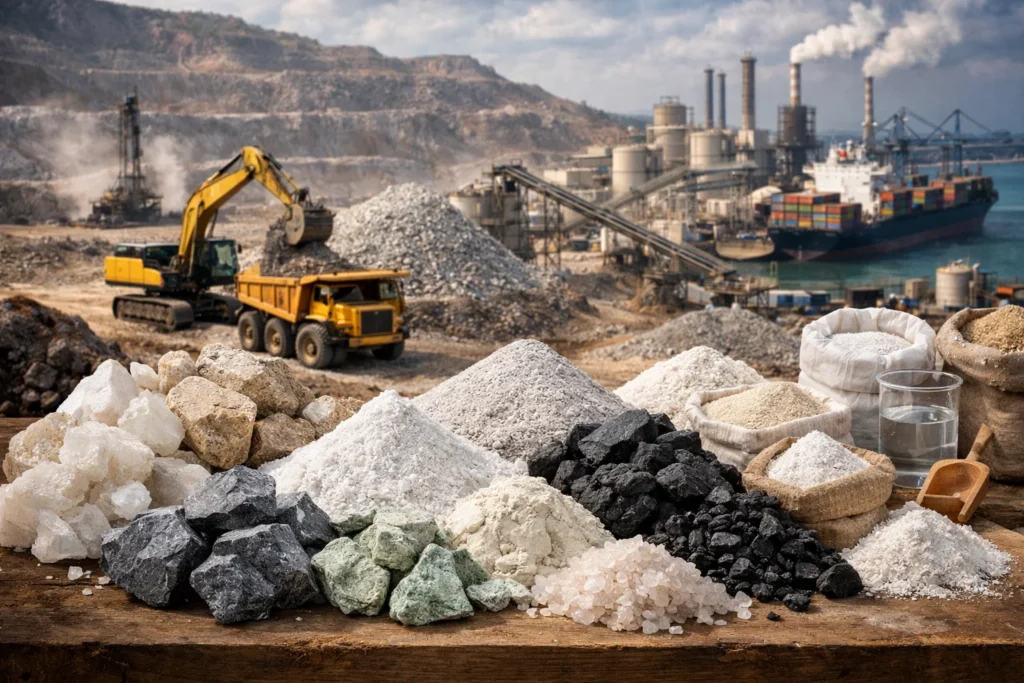
Industrial minerals are naturally occurring non-metallic materials extracted from the earth and processed for their physical and chemical properties. Unlike fuels or metals, industrial minerals are valued for their unique characteristics, making them essential raw materials across multiple industries. They are widely used as raw materials, fillers, additives, and performance enhancers in construction, manufacturing, agriculture, electronics, and energy sectors.
Understanding industrial minerals is critical for buyers and industry professionals because these materials impact product quality, performance, and production costs. This guide provides a detailed overview of industrial minerals, including types, uses, properties, global market trends, and sourcing guidance for buyers worldwide.
Industrial minerals are obtained through mining or quarrying and then processed through crushing, grinding, washing, and grading to meet specific industrial standards. Their properties, such as hardness, thermal stability, particle size, and chemical composition, determine how they are used in manufacturing, construction, and other applications.
Why Industrial Minerals Are Important for Buyers
Industrial minerals are essential because they:
- Enhance product strength, durability, and workability
- Provide chemical and thermal stability in industrial processes
- Reduce production costs through fillers and additives
- Enable advanced manufacturing in electronics, ceramics, glass, and energy sectors
- Support global infrastructure and technological development
For buyers, selecting the right mineral with the correct grade and quality ensures consistent product performance and long-term reliability. Industrial minerals are increasingly important due to rising global demand and new applications in technology and renewable energy.
Types of Industrial Minerals and Their Uses
Industrial minerals are categorized based on their properties and applications. Below are the most common types:
Silica Sand
Silica sand, composed primarily of silicon dioxide (SiO₂), is one of the most widely used industrial minerals.
Uses:
- Glass manufacturing (float glass, container glass, fiberglass)
- Foundry molds and cores
- Construction materials like concrete, mortar, and flooring
- Water filtration
- Hydraulic fracturing in oil and gas industry
Silica sand is available in different grades based on purity and particle size, allowing buyers to select the appropriate grade for specific applications.
Limestone
Limestone is mainly composed of calcium carbonate (CaCO₃) and is essential in construction and manufacturing.
Uses:
- Cement production
- Lime manufacturing
- Road base and aggregates
- Soil conditioning and agricultural applications
- Steel manufacturing flux
Limestone is widely traded globally due to its versatility and critical role in infrastructure.
Clay Minerals (Kaolin, Ball Clay, Bentonite)
Clays are valued for their plasticity, binding, and absorption properties.
Uses:
- Ceramics (tiles, sanitary ware, pottery)
- Paper coating and filler
- Paints and coatings
- Drilling mud in oil and gas exploration
- Foundry molds and cores
Different types of clay are chosen depending on mineral composition, plasticity, and desired industrial application.
Gypsum
Gypsum is a soft sulfate mineral widely used in construction and cement manufacturing.
Uses:
- Gypsum boards and plaster
- Cement additive to control setting time
- Soil conditioner for agriculture
- Decorative plaster products
Gypsum improves fire resistance and workability in construction materials.
Feldspar
Feldspar is an aluminosilicate mineral group used mainly in glass and ceramics.
Uses:
- Glass production
- Ceramic tiles and sanitary ware
- Filler in paints and plastics
- Glazes and enamels
Feldspar acts as a flux in ceramics and glass, lowering melting temperatures and enhancing product strength.
Barite
Barite (barium sulfate) is valued for its high density.
Uses:
- Weighting agent in drilling fluids
- Radiation shielding in industrial and medical applications
- Filler in paints and plastics
Barite is essential in oil and gas drilling and provides stability in deep wells.
Graphite
Graphite is a carbon-based mineral with excellent conductivity and heat resistance.
Uses:
- Batteries and electric vehicles
- Refractories for high-temperature applications
- Lubricants and brake linings
- Electrodes in steel manufacturing
Graphite demand is rising due to renewable energy and advanced technology sectors.
Mica
Mica is valued for its insulating and heat-resistant properties.
Uses:
- Electrical insulation
- Paints and coatings
- Cosmetics
- Construction materials
Mica ensures reliability in high-temperature and electrical applications.
Key Properties and Benefits of Industrial Minerals
Industrial minerals are selected based on:
- Hardness and strength for durability
- Heat resistance for high-temperature applications
- Chemical stability to prevent reactions
- Particle size and shape for optimal processing
- Purity and low contamination for high-performance applications
Benefits for buyers and manufacturers:
- Improved product durability and strength
- Enhanced thermal and chemical resistance
- Cost efficiency through filler usage
- Better surface finish and product quality
These factors make industrial minerals indispensable across industries worldwide.
Industrial Minerals Applications Across Industries
Industrial minerals support multiple sectors globally:
- Construction and Infrastructure: Limestone, gypsum, silica sand for cement, concrete, bricks, tiles, boards
- Glass and Ceramics: Silica, feldspar, kaolin for heat resistance, strength, and texture
- Metallurgical: Limestone and dolomite act as fluxes in steel production
- Chemical and Coatings: Talc, kaolin, silica as fillers and additives in paints, plastics, coatings
- Agriculture: Limestone and gypsum improve soil pH, nutrient availability, and crop yield
- Electronics and Energy: High-purity minerals in semiconductors, batteries, solar panels
Global Market Trends
Industrial minerals are affected by urbanization, industrial growth, and technological advancement:
- Construction Boom: Rapid urbanization in Asia, Africa, and Latin America drives demand for limestone, gypsum, and silica sand.
- Renewable Energy & EV Growth: Graphite and high-purity silica are increasingly used in batteries, solar panels, and energy storage systems.
- Sustainable Sourcing: Buyers prioritize suppliers that follow responsible mining practices and environmental compliance.
- Supply Chain Dynamics: Logistics, trade policies, and geopolitical factors influence availability and pricing. Diversifying suppliers mitigates risks.
How Buyers Select Industrial Minerals
Key considerations for buyers:
- Purity & Chemical Composition: Essential for glass, ceramics, and electronics
- Particle Size & Shape: Influences processing behavior and product quality
- Processing Requirements: Grinding, washing, or drying may be needed
- Physical Properties: Hardness, density, and thermal behavior
- Supply Reliability: Consistent quality and delivery are essential
Reliable industrial mineral suppliers should provide quality assurance, technical support, and flexible shipping options. Buyers must evaluate pricing, contract terms, and sustainability compliance.
Conclusion
Industrial minerals are critical for modern industries and global infrastructure. They enhance product performance, durability, and cost-efficiency. Understanding their types, applications, properties, and sourcing requirements enables buyers to make informed decisions.
As global demand grows, prioritizing quality, consistency, and reliable suppliers ensures long-term operational success. Industrial minerals remain vital for industrial, technological, and infrastructure development worldwide.
FAQs
Q1: What are industrial minerals?
A1: Non-metallic minerals used in industrial applications due to their physical and chemical properties, not for fuels or metals.
Q2: What are the common types of industrial minerals?
A2: Silica sand, limestone, clay, gypsum, feldspar, barite, graphite, and mica.
Q3: Which industries use industrial minerals?
A3: Construction, glass, ceramics, chemicals, agriculture, electronics, and energy.
Q4: How should buyers select industrial minerals?
A4: Consider purity, particle size, chemical composition, processing needs, and supply reliability.
Q5: Can industrial minerals be sourced globally?
A5: Yes, industrial minerals are globally traded and can be sourced from reliable international suppliers.
Q6: What are the benefits of industrial minerals?
A6: Improved product strength, durability, heat and chemical resistance, and processing efficiency.