

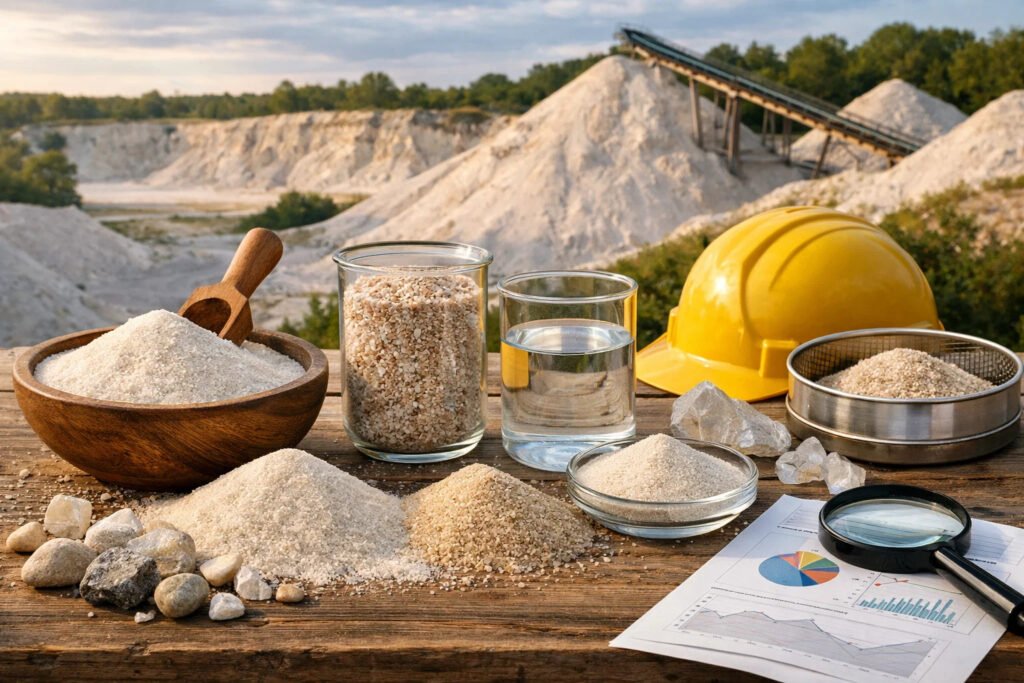
Silica sand is one of the most essential industrial minerals used across multiple industries in India. Its unique physical and chemical properties make it a valuable raw material for applications ranging from glass manufacturing to construction and water filtration. As industrial demand continues to grow, understanding silica sand in detail has become increasingly important for manufacturers, buyers, and industry professionals.
This in-depth guide explains what silica sand is, its chemical formula, uses of silica sand, types of silica sands, grades, HSN code, silica sand prices, and the role of silica sand suppliers and manufacturers in India. This pillar content is designed to help you make informed decisions while choosing the right silica sand for your needs.
What Is Silica Sand
Silica sand is a naturally occurring granular material composed primarily of silicon dioxide, commonly written as SiO₂. It is formed over millions of years through the natural weathering of rocks rich in quartz. These quartz particles break down into fine grains and are deposited in riverbeds, deserts, beaches, and sand deposits.
The quality of silica sand depends on several factors, such as silica content, particle size, shape, and impurity levels. High-purity silica sand is highly valued because it delivers better performance and consistency in industrial applications. In India, silica sand deposits are found in states like Rajasthan, Gujarat, Tamil Nadu, Andhra Pradesh, and Odisha.
Silica sand is known for its hardness, durability, and resistance to heat and chemicals. These qualities make it suitable for demanding industrial environments where stability and reliability are critical.
Silica Sand Chemical Formula
The chemical formula of silica sand is SiO₂, which represents silicon dioxide. Each particle of silica sand consists of one silicon atom bonded to two oxygen atoms. This strong molecular structure gives silica sand its exceptional physical properties.
Silica sand can contain trace amounts of other minerals such as iron oxide, alumina, calcium, and magnesium. These impurities affect the color, clarity, and usability of the sand. For example, silica sand used in glass manufacturing requires very low iron content to ensure transparency.
To meet industrial standards, silica sand is often processed through washing, grading, and purification methods. This improves its purity and ensures consistent performance in high-end applications.
Uses of Silica Sand
The uses of silica sand span across multiple industries due to its strength, stability, and versatility.
Glass Manufacturing
The glass industry is the largest consumer of silica sand. It is the main raw material used to manufacture container glass, float glass, fiberglass, and specialty glass products. High-purity silica sand ensures better clarity, strength, and uniformity in glass production.
Foundry Industry
Silica sand is widely used in the foundry industry to create molds and cores for metal casting. Its ability to withstand high temperatures makes it ideal for shaping molten metal. Foundry silica sand must have a consistent grain size and good thermal stability to reduce casting defects.
Water Filtration
In water treatment systems, silica sand acts as an effective filtration medium. Filter-grade silica sand removes suspended particles, impurities, and sediments from water. Its uniform particle size ensures efficient filtration and long service life.
Construction Industry
Silica sand plays an important role in construction. It is used in concrete, mortar, cement, plastering, and flooring applications. Silica sand improves strength, durability, and surface finish in construction materials.
Refractory and Ceramics
Silica sand is used in the manufacturing of refractory products and ceramics. It provides heat resistance and structural stability in furnaces, kilns, and high-temperature equipment. In ceramics, it improves hardness and thermal performance.
Paints and Coatings
In paints and coatings, silica sand enhances texture, abrasion resistance, and durability. It helps improve surface strength and coating performance in industrial and decorative applications.
Sports and Landscaping
Silica sand is also used in sports fields, golf courses, artificial turf, and landscaping projects. It offers excellent drainage, stability, and natural appearance.
Types of Silica Sand
There are different types of silica sands available based on application requirements.
Foundry Grade Silica Sand
Used for metal casting molds and cores. This type offers high thermal resistance and consistent grain structure.
Glass-Grade Silica Sand
This is the purest form of silica sand with minimal impurities. It is mainly used for glass manufacturing where clarity and quality are essential.
Filter Grade Silica Sand
Designed specifically for water filtration systems. It is processed to achieve uniform particle size and optimal filtration efficiency.
Construction-Grade Silica Sand
Used in concrete, mortar, and construction materials. It is available in multiple sizes to suit different building applications.
Frac Sand
Frac sand is used in oil and gas operations for hydraulic fracturing. It requires high strength and round grain shape to maintain fractures under pressure.
Silica Sand Grades
Silica sand grades are determined by particle size and purity. Choosing the correct grade ensures optimal performance.
- Fine-grade silica sand is used in filtration and chemical applications
- Medium-grade silica sand is used in foundry and construction
- Coarse-grade silica sand is used in concrete and heavy industrial uses
Grades are commonly measured using mesh sizes such as 8 to 16 mesh and 16 to 30 mesh.
Silica Sand HSN Code
In India, silica sand is classified under the HSN system for GST compliance. It falls under the category of natural sands. The exact silica sand HSN code depends on the processing level and product type. Correct HSN classification is essential for accurate billing, taxation, and logistics.
Silica Sand Prices in India
Silica sand prices vary depending on purity, grade, mesh size, processing, and location. Market demand and transportation costs also influence pricing.
Approximate silica sand price ranges in India:
- The general silica sand price ranges from 2500 to 4000 INR per ton
- Foundry-grade silica sand price ranges from 4000 to 6000 INR per ton
- Glass-grade silica sand price ranges from 6000 to 10000 INR per ton
- Filter-grade silica sand price ranges from 3000 to 5000 INR per ton
For accurate and current pricing, it is best to consult directly with Puresil.
Silica Sand Suppliers in India
India has a strong network of silica sand suppliers serving different industries. These suppliers provide customized grades, bulk supply, and logistics support across regions.
When selecting a silica sand supplier in India, key factors to consider include:
- Product quality and consistency
- Reliable supply capacity
- Transparent pricing
- Timely delivery
- Compliance with regulations
Silica Sand Manufacturers in India
Silica sand manufacturers in India operate processing units that focus on washing, grading, and quality control. Manufacturers ensure that silica sand meets industry standards and customer specifications.
Working with a reliable silica sand manufacturer ensures long-term supply stability, consistent quality, and cost efficiency.
Why Choose PureSil as Your Silica Sand Supplier
PureSil is a trusted silica sand supplier in India, offering high-quality silica sand for a wide range of industrial applications. PureSil focuses on delivering consistent quality, accurate grading, and reliable supply.
PureSil provides:
- High-purity silica sand
- Multiple grades and mesh sizes
- Competitive silica sand prices
- Reliable logistics and delivery
- Strong customer support
PureSil works closely with industries to meet their specific silica sand requirements and support long-term growth.
Conclusion
Silica sand is a vital industrial material that supports glass manufacturing, foundry operations, water filtration, construction, and many other industries. Understanding what silica sand is, its chemical formula, uses, types, grades, HSN code, prices, and suppliers in India helps businesses make better purchasing decisions.
If you are looking for a reliable silica sand supplier in India, PureSil offers quality, consistency, and dependable service to meet your industrial needs.
FAQ’s
Q1. Why is silica sand important for industries
A1. Silica sand is important because it has high hardness, heat resistance, and chemical stability. These properties make it suitable for glass manufacturing, foundry work, construction, water filtration, and many other industrial uses.
Q2. Is silica sand natural or manufactured
A2. Silica sand is a natural material. It is mined from natural deposits and then processed through washing and grading to meet industrial quality requirements.
Q3. Which industries use high purity silica sand
A3. High purity silica sand is mainly used in glass manufacturing, foundry casting, water filtration, ceramics, and refractory industries where quality and consistency are critical.
Q4. What factors affect silica sand quality
A4. Silica sand quality depends on silica content, particle size, shape, moisture level, and impurity content such as iron or clay.
Q5. Is silica sand safe to use
A5. Silica sand is safe to use when handled properly. In industrial environments, proper safety measures should be followed to control dust and ensure worker safety.
Q6. Does silica sand absorb water
A6. Silica sand does not absorb water but allows water to pass through easily. This makes it ideal for filtration and drainage applications.