Kaolin clay is one of the most widely used industrial minerals across ceramics, paper, paints, rubber, plastics, and construction industries. Known for its fine particle size, chemical stability, and high whiteness, kaolin plays a critical role in improving product performance and finish quality.
If you are exploring what kaolin clay is, its industrial applications, and its technical properties, this detailed guide will help you understand everything, including how to choose a reliable kaolin clay supplier for bulk industrial requirements.
What is Kaolin Clay?
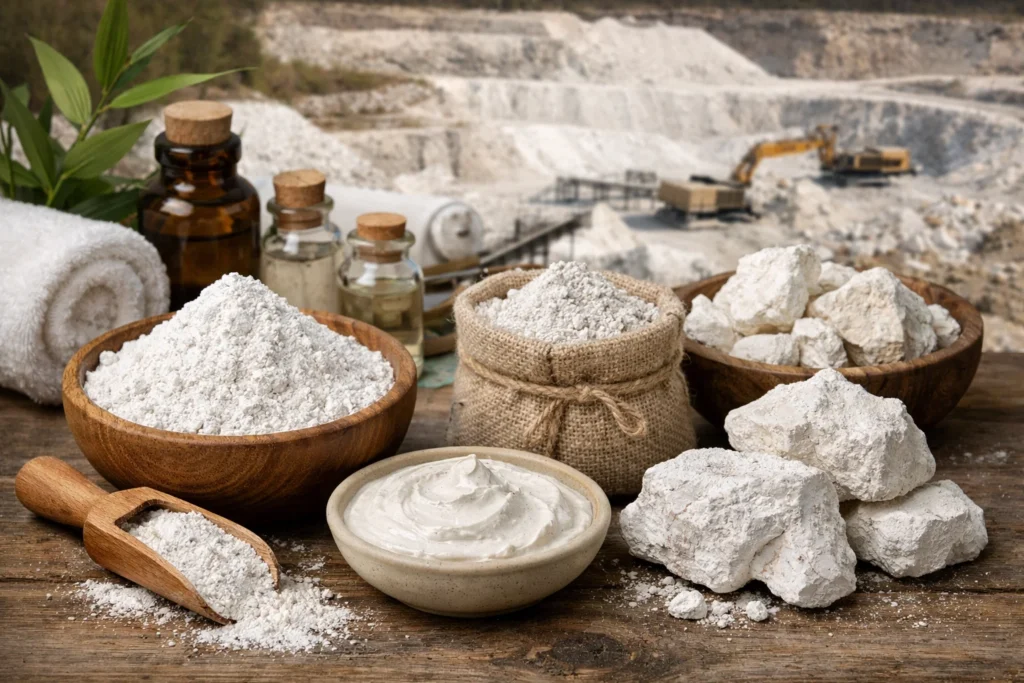
Kaolin clay, also known as china clay, is a naturally occurring soft white clay primarily composed of the mineral kaolinite. It forms through the weathering of feldspar-rich rocks over long geological periods.
Its chemical composition mainly includes:
- Hydrated aluminum silicate
- Low iron content (in high-grade variants)
- Fine particle structure
Due to its purity and consistent physical properties, kaolin is extensively used in industrial manufacturing processes worldwide.
Chemical and Physical Properties of Kaolin Clay
Understanding kaolin clay properties is essential for industrial buyers.
Key Chemical Properties
- High alumina content
- Low impurities (in refined grades)
- Stable chemical structure
- Low reactivity
Key Physical Properties
- Fine particle size distribution
- High brightness and whiteness
- Low shrink-swell capacity
- Soft texture
- Good dispersion characteristics
These properties make kaolin suitable for high-performance industrial applications.
Types of Kaolin Clay
There are different types of kaolin clay depending on the processing method and industrial use.
1. Raw Kaolin Clay
Unprocessed natural kaolin, typically used in applications where ultra-high refinement is not required.
2. Washed Kaolin
Processed to remove impurities and improve brightness, widely used in ceramics and paper coating.
3. Calcined Kaolin
Heat-treated kaolin with improved hardness, brightness, and opacity, commonly used in paints, rubber, and plastics.
4. Surface-Modified Kaolin
Treated to enhance compatibility with polymers and specialty coatings.
Each type is selected based on technical specifications and application needs.
Uses of Kaolin Clay in Various Industries
The uses of kaolin clay extend across multiple industries globally.
1. Ceramic Industry
Kaolin is a key raw material in:
- Tiles
- Sanitaryware
- Porcelain
- Tableware
It provides plasticity during shaping and strength after firing.
2. Paper Industry
Kaolin improves:
- Surface smoothness
- Printability
- Brightness
- Ink absorption
It is widely used as both filler and coating material.
3. Paint and Coatings
Kaolin enhances:
- Opacity
- Suspension stability
- Film strength
- Surface finish
It helps reduce formulation cost while improving durability.
4. Rubber and Plastics
In rubber manufacturing, kaolin improves:
- Tensile strength
- Abrasion resistance
- Processing stability
It also acts as a functional filler in plastic compounds.
5. Construction Materials
Kaolin is used in:
- Cement formulations
- White cement production
- Specialty construction materials
Its chemical stability ensures consistent performance.
Benefits of Kaolin Clay for Industrial Applications
The growing global demand for kaolin is driven by its multiple industrial advantages.
Key Kaolin Clay Benefits
- High brightness and whiteness
- Improved mechanical strength in ceramics
- Cost-effective filler solution
- Thermal stability
- Low impurity levels
- Smooth surface finish enhancement
These benefits make kaolin a preferred mineral in competitive manufacturing environments.
Global Demand for Kaolin Clay
Countries such as India, Japan, Vietnam, and the Philippines continue to see growing demand for industrial-grade kaolin due to expansion in:
- Ceramic manufacturing
- Infrastructure development
- Paper production
- Paint and coatings industries
Manufacturers in these markets often rely on established mineral exporters for consistent bulk supply and quality assurance.
How to Choose the Right Kaolin Clay Supplier
Selecting the right Kaolin Clay Supplier is critical for long-term manufacturing stability.
When evaluating suppliers, consider:
- Consistent chemical composition
- Particle size control
- Processing facilities
- Export capability
- Bulk supply capacity
- Technical support and documentation
Reliable suppliers provide laboratory test reports and ensure quality consistency across shipments.
Why Source Kaolin Clay from India?
India is recognized as a major exporter of industrial minerals due to:
- Large mineral reserves
- Advanced processing facilities
- Competitive production costs
- Strong export infrastructure
Indian suppliers serve global markets with structured quality control and scalable production capacity.
For industrial buyers seeking consistent bulk supply, working with an experienced Indian exporter ensures long-term sourcing stability.
Applications-Based Grade Selection
Before placing an order, buyers should define:
- Required brightness level
- Particle size distribution
- Moisture limits
- Intended industrial application
- Monthly volume requirement
Clear technical specifications reduce procurement risks and ensure compatibility with production processes.
Sustainable and Efficient Supply Chain Considerations
Modern industrial procurement requires more than just raw material sourcing.
Buyers should also evaluate:
- Packaging standards
- Bulk shipment options
- Lead time consistency
- Documentation compliance
- Long-term pricing stability
Structured sourcing improves operational efficiency and reduces unexpected supply disruptions.
Conclusion
Kaolin clay remains one of the most versatile and widely used industrial minerals globally. From ceramics and paper to paints and plastics, its fine particle structure, chemical stability, and brightness make it essential for high-performance manufacturing.
Understanding what is kaolin clay, its types, properties, benefits, and industrial applications enables manufacturers to make informed sourcing decisions.
Partnering with an experienced Kaolin Clay Supplier ensures consistent quality, reliable bulk supply, and long-term operational efficiency in competitive industrial markets.
Frequently Ask Questions
Kaolin clay is primarily used in ceramics, paper coating, paints, rubber, and construction materials.
The main types include raw kaolin, washed kaolin, calcined kaolin, and surface-modified kaolin.
Kaolin offers high brightness, fine particle size, chemical stability, and low impurity levels.
It provides plasticity during shaping and strength after firing, improving final product durability.
Look for consistent quality control, export experience, laboratory testing support, and bulk production capacity.