
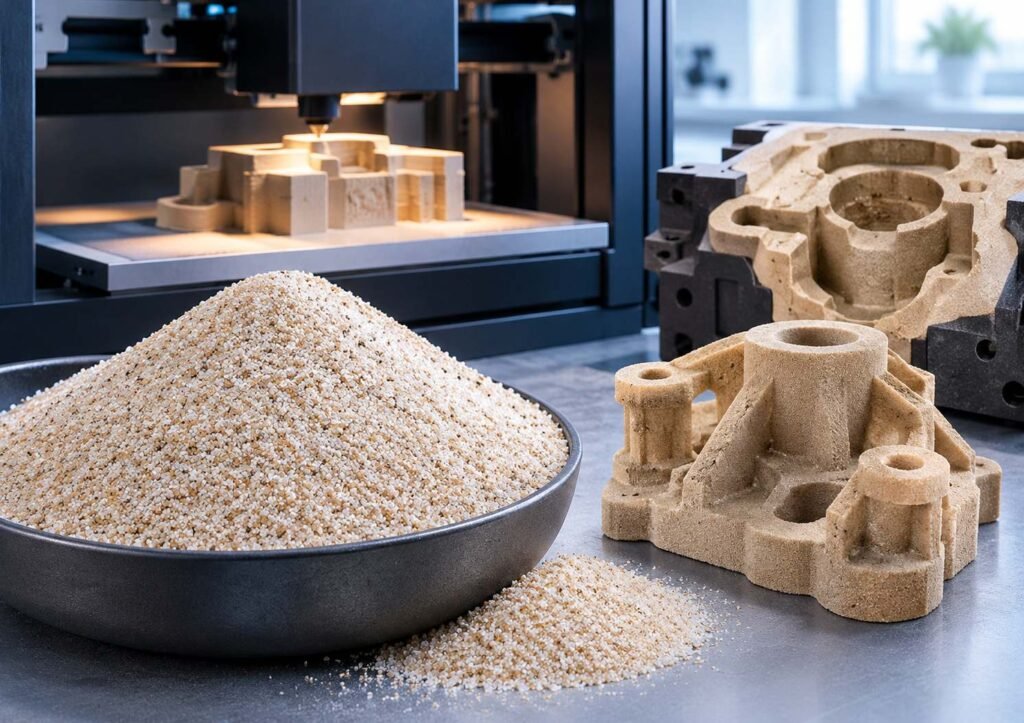
3D printing has transformed modern manufacturing by making it easier to produce complex shapes, reduce tooling requirements, and accelerate product development. One material playing an important role in this transformation is silica sand for 3D printing, particularly in metal casting and foundry applications.
Unlike conventional plastic 3D printing, sand-based additive manufacturing enables foundries to create intricate molds and cores directly from digital designs. Choosing the right sand quality is essential for achieving consistent printing performance, dimensional accuracy, and reliable casting results.
What Is Silica Sand for 3D Printing?
Silica sand is a naturally occurring granular material primarily composed of silicon dioxide (SiO₂). In industrial 3D printing, specially selected silica sand is commonly used as the base material for producing molds and cores through a process called binder jetting.
During this process, a printer spreads thin layers of sand and selectively deposits a liquid binder onto specific areas. Layer by layer, the binder joins the sand particles to form the required three-dimensional structure.
The resulting mold or core can then be used to manufacture metal components with complex internal passages, detailed geometries, and reduced dependence on conventional tooling.
Key Benefits of Silica Sand in 3D Printing
1. Supports complex designs
Sand 3D printing makes it possible to produce intricate mold cavities, internal channels, and customized core geometries that may be difficult or expensive to create using traditional methods.
2. Reduces tooling requirements
Because molds and cores can be generated directly from CAD files, foundries can reduce their reliance on dedicated patterns and core boxes. This is particularly useful for prototypes, low-volume production, and customized castings.
3. Offers high-temperature suitability
Silica sand is widely used in foundry applications because of its refractory properties. When correctly specified for the casting process, it can withstand the thermal conditions involved in many metal-casting operations.
4. Helps improve production flexibility
Digital manufacturing allows design modifications without manufacturing an entirely new set of conventional tools. This can help shorten development cycles and support more responsive production planning.
Important Properties to Consider When Selecting 3D Printing Sand
Not every grade of silica sand is suitable for additive manufacturing. Buyers should evaluate several technical characteristics before selecting a material.
- Grain size and distribution: Consistent particle sizing helps produce uniform layers and influences surface finish, packing, and dimensional accuracy.
- Grain shape: Particle morphology affects flowability, packing behavior, and the ability of the recoater to spread sand evenly.
- Purity and clay content: Appropriate silica content and controlled impurities help maintain predictable material behavior.
- Flowability: Sand must spread consistently across the printing bed to support reliable layer formation.
- Moisture content: Excess moisture can affect binder behavior, material handling, and printing consistency.
- Binder compatibility: The sand must work with the printer’s binder chemistry and process settings.
The ideal specifications depend on the printer model, layer thickness, binder system, and intended casting application.
Applications of Silica Sand for 3D Printing
Silica sand is especially valuable in foundry-based additive manufacturing. Common applications include automotive casting molds, industrial machinery components, pump housings, complex engine parts, and customized metal castings.
It is also useful for rapid prototyping, where manufacturers need to test component designs before committing to conventional tooling. By producing molds directly from digital models, businesses can explore design changes with greater flexibility.
How to Choose a Reliable Silica Sand Supplier
When sourcing silica sand for 3D printing, consider more than the purchase price. Evaluate material consistency, particle-size specifications, technical documentation, quality-control procedures, and the supplier’s ability to meet recurring requirements.
Request a technical datasheet and confirm that the proposed grade meets your printer and foundry process requirements. Trial batches can help validate flowability, binder compatibility, and finished mold performance before large-scale procurement.
Businesses looking for industrial silica sand can explore Puresil silica sand products to learn more about available material options and discuss their application requirements.
Conclusion
Silica sand for 3D printing is an important material for modern foundries seeking design flexibility, efficient mold production, and reduced tooling dependence. The right grade can contribute to consistent layer formation, reliable mold performance, and better control over manufacturing outcomes.
Before purchasing, prioritize grain-size consistency, purity, flowability, moisture control, and compatibility with your printing system. Working with a dependable Silica Sand supplier can help manufacturers identify a suitable material and build a more consistent sand 3D printing process.
Technical basis: Research on sand binder jetting identifies grain-size distribution, morphology, flowability, recoating behavior, and binder compatibility as important material-selection considerations.
Frequently Ask Questions
Silica sand for 3D printing is a granular material primarily composed of silicon dioxide (SiO₂), used in sand-based additive manufacturing. It is commonly used with binder jetting technology to produce molds and cores for metal casting.
A 3D printer spreads thin layers of silica sand and selectively deposits a liquid binder onto the required areas. The process repeats until the mold or core is complete, after which loose sand is removed and the printed component is prepared for casting.
Suitable silica sand should have a controlled particle-size distribution, consistent grain shape, good flowability, appropriate purity, and compatibility with the printer's binder system. The exact specifications depend on the equipment and intended application.
Key benefits include producing complex mold geometries, reducing dependence on conventional tooling, supporting rapid prototyping, and improving manufacturing flexibility for customized metal castings.
Yes. Silica sand is widely used to manufacture foundry molds and cores for metal casting. Sand-based 3D printing allows these components to be created directly from digital designs, including complex shapes and internal passages.
Grain size influences layer formation, packing behavior, surface finish, permeability, and dimensional accuracy. A consistent particle-size distribution helps achieve predictable printing results, but the ideal size depends on the printer and casting requirements.
Not always. Conventional foundry sand may not have the particle-size distribution, flowability, or recoating characteristics required by a specific 3D printer. The sand should be tested against the equipment manufacturer's material specifications.
Evaluate the supplier's product specifications, grain-size consistency, purity, moisture control, quality assurance, and ability to provide repeatable batches. Request a technical datasheet and sample material for testing before placing bulk orders.
It can contribute to consistent mold production when its properties are matched to the printing process. However, final casting quality also depends on binder chemistry, mold design, printing parameters, metal temperature, and casting practices.
You can explore Puresil silica sand product range and contact the supplier to discuss your application, required specifications, and material suitability for sand-based 3D printing.