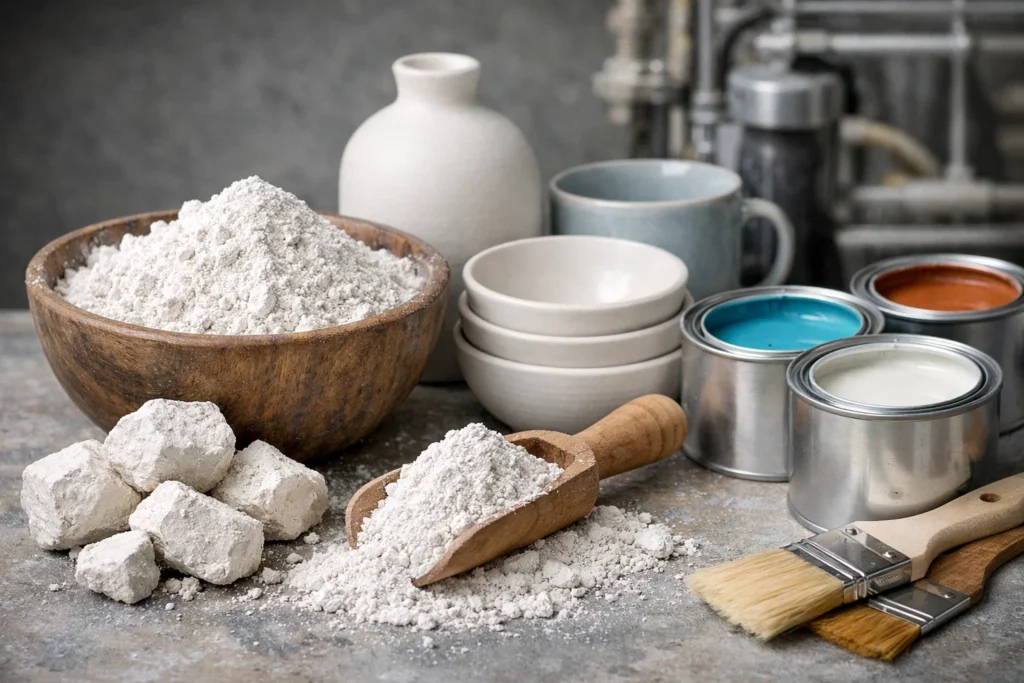
Kaolin clay is one of the most widely used industrial minerals due to its purity, chemical stability, and versatile performance in manufacturing processes. This naturally occurring clay mineral is primarily composed of hydrated aluminum silicate and is valued for its fine particle size, whiteness, and smooth texture.
Industries such as ceramics, paints, coatings, paper, and plastics depend on kaolin clay for improving product quality and production efficiency. Because of its unique mineral properties, kaolin plays an important role in enhancing durability, improving surface finish, and supporting consistent manufacturing results.
Understanding the key benefits of kaolin clay in different industrial sectors helps manufacturers select the right mineral materials for their production processes.
What Makes Kaolin Clay Valuable in Industrial Applications
Kaolin clay possesses several mineral characteristics that make it suitable for a wide range of industrial uses. Its physical and chemical properties allow it to function both as a functional filler and as a processing material in manufacturing operations.
Important characteristics of kaolin clay include:
• High purity and stable mineral composition
• Fine particle size and smooth texture
• Excellent whiteness and brightness
• Good chemical resistance
• Consistent performance in industrial formulations
These properties allow kaolin clay to support various production processes while improving the performance of finished products.
Key Benefits of Kaolin Clay in Industrial Manufacturing
Kaolin clay provides several advantages that make it an essential mineral resource for many industries. These benefits contribute to improved material performance, better product quality, and more efficient manufacturing operations.
High Purity and Chemical Stability
One of the most important kaolin clay benefits is its high purity and stable chemical composition. This allows manufacturers to use the mineral in applications where consistent material quality is required.
The stable mineral structure also helps maintain performance under different processing conditions, including high temperatures used in industrial production.
Improves Product Strength and Durability
Kaolin clay contributes to the strength and durability of many manufactured products. When used as a filler or raw material, it helps improve structural integrity and resistance to wear.
This benefit is particularly important in industries where materials must withstand mechanical stress and environmental exposure.
Excellent Whiteness and Surface Finish
Kaolin clay is valued for its natural whiteness and fine particle structure. These characteristics help improve the surface finish and visual appearance of industrial products.
Manufacturers use kaolin clay to produce smooth and uniform surfaces in products such as ceramics, coatings, and other manufactured materials.
Improves Process Efficiency in Manufacturing
Kaolin clay helps improve processing efficiency in various industrial operations. Its consistent particle size and mineral composition allow manufacturers to achieve predictable results during production.
This consistency supports better quality control and reduces variations in finished products.
Cost-Effective Industrial Mineral
Another important benefit of kaolin clay is its cost effectiveness. Because the mineral is widely available and can be processed efficiently, it provides a reliable raw material for large-scale industrial production.
Manufacturers often choose kaolin clay because it helps improve product performance while maintaining cost-efficient production processes.
Kaolin Clay in the Ceramics Industry
The ceramics industry is one of the largest consumers of kaolin clay. In ceramic manufacturing, kaolin plays an important role as a primary raw material used in the production of tiles, sanitaryware, porcelain, and tableware.
Kaolin clay contributes several advantages in ceramic production, including:
• Improved plasticity during shaping processes
• Enhanced strength of ceramic bodies
• Better surface smoothness and finish
• Consistent firing behavior during kiln processing
These properties help ceramic manufacturers produce high-quality products with improved durability and aesthetic appearance.
Kaolin Clay in the Paint Industry
Kaolin clay is widely used in the paint and coatings industry as a functional mineral filler. Its fine particle size and brightness make it suitable for improving the performance of paint formulations.
In paint manufacturing, kaolin clay helps provide:
• Improved coating smoothness
• Better paint coverage and opacity
• Enhanced durability of painted surfaces
• Improved resistance to weathering and wear
These benefits allow paint manufacturers to produce coatings with better performance and longer service life.
Other Industrial Applications of Kaolin Clay
Beyond ceramics and paints, kaolin clay is used in several other industrial sectors where mineral fillers and processing materials are required.
Common industrial uses include:
• Paper manufacturing
• Plastics production
• Rubber processing
• Construction materials
• Adhesives and sealants
In these industries, kaolin clay helps improve product performance, stability, and overall manufacturing efficiency.
Conclusion
Kaolin clay remains one of the most important industrial minerals used across a wide range of manufacturing sectors. Its natural purity, chemical stability, and fine particle characteristics make it valuable for applications in ceramics, paints, coatings, and other industrial materials.
The benefits of kaolin clay extend beyond simple mineral composition. Its ability to improve product strength, enhance surface quality, and support efficient production processes makes it an essential raw material for modern manufacturing industries.
As industrial demand continues to grow, kaolin clay will remain a key mineral resource supporting high-quality production across global manufacturing sectors.
Frequently Ask Questions
Kaolin clay benefits include high purity, chemical stability, improved product strength, smooth surface finish, and consistent performance in industrial manufacturing processes.
Kaolin clay is used in ceramics because it improves plasticity, strengthens ceramic bodies, and supports stable firing during kiln processing.
In the paint industry, kaolin clay functions as a mineral filler that improves coating smoothness, durability, and coverage.
Industries such as ceramics, paints, paper manufacturing, plastics, rubber processing, and construction materials use kaolin clay in production processes.
Kaolin clay is valuable because of its high purity, fine particle size, natural whiteness, and ability to improve the performance of industrial materials.