
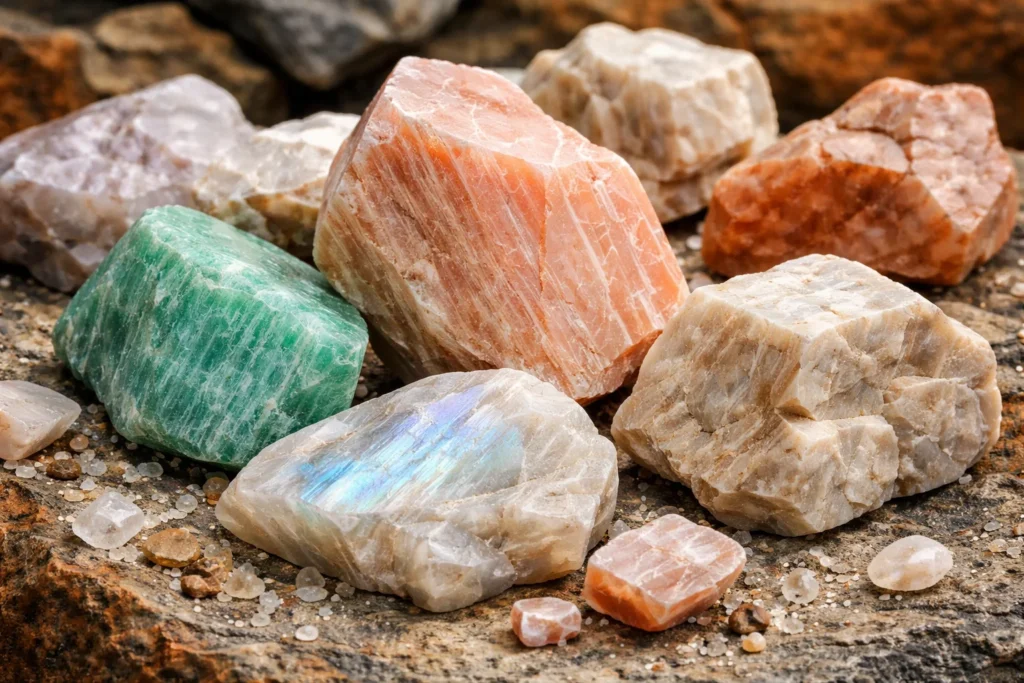
Feldspar is one of the most abundant mineral groups found in the Earth’s crust and plays a critical role in many industrial manufacturing processes. It is widely used as a raw material in industries such as ceramics, glass manufacturing, construction materials, paints, and plastics. Because of its chemical stability and ability to act as a fluxing agent, feldspar helps improve the efficiency and performance of industrial production.
Industries rely on feldspar minerals to enhance the strength, durability, and appearance of finished products. Its presence in manufacturing processes allows producers to reduce melting temperatures and improve the quality of materials used in various industrial applications.
Understanding what feldspar is, its mineral composition, properties, types, and industrial uses helps manufacturers and industrial buyers select the appropriate material for their production needs.
What is Feldspar
Feldspar refers to a large group of rock-forming minerals that belong to the tectosilicate mineral family. These minerals are primarily composed of aluminum silicates combined with potassium, sodium, or calcium.
Feldspar minerals are commonly found in igneous, metamorphic, and sedimentary rocks. Because of their abundance and useful physical properties, feldspar minerals are widely mined and processed for industrial applications.
The crystalline structure of feldspar consists of interconnected silicon and aluminum atoms that form a stable mineral framework. This structure gives feldspar its hardness, durability, and resistance to chemical reactions.
One of the most important characteristics of feldspar is its ability to act as a flux during manufacturing processes. This property helps lower the melting temperature of raw material mixtures, making feldspar an essential component in industries such as ceramics and glass manufacturing.
Feldspar Chemical Composition
The feldspar chemical formula varies depending on the specific mineral type present within the feldspar group. These minerals are mainly composed of aluminum silicates combined with potassium, sodium, or calcium.
The most common feldspar chemical compositions include:
• Potassium feldspar – KAlSi₃O₈
• Sodium feldspar – NaAlSi₃O₈
• Calcium feldspar – CaAl₂Si₂O₈
These minerals form different variations within the feldspar group depending on the relative proportion of these elements in the crystal structure.
The chemical composition of feldspar plays an important role in determining its industrial performance, melting characteristics, and compatibility with manufacturing processes.
Types of Feldspar Minerals
The feldspar mineral group is generally divided into several types based on its chemical composition and crystal structure.
The main types of feldspar minerals include:
• Potassium feldspar
• Sodium feldspar
• Calcium feldspar
Potassium Feldspar
Potassium feldspar is widely used in industrial applications, especially in ceramic and glass manufacturing. It contains potassium as the dominant element in its chemical structure.
This mineral is valued for its fluxing properties that help reduce the melting temperature during production processes.
Sodium Feldspar
Sodium feldspar contains sodium as the primary element in its composition. It is commonly used in glass production where it helps improve product clarity, hardness, and resistance to chemical corrosion.
Calcium Feldspar
Calcium feldspar is another member of the feldspar mineral group. Although it is present in many geological formations, it is less frequently used in industrial manufacturing compared to potassium and sodium feldspar.
Feldspar Properties
Feldspar minerals possess several physical and chemical characteristics that make them suitable for industrial manufacturing.
Important feldspar properties include:
• Hardness of around 6 on the Mohs scale
• Good resistance to chemical reactions
• High melting stability
• Moderate density
• Crystalline mineral structure
• Ability to function as a flux in manufacturing processes
These properties allow feldspar to improve the strength, durability, and performance of industrial products.
The fluxing ability of feldspar is particularly important because it reduces melting temperatures during production and contributes to the formation of a glassy phase that strengthens finished materials.
Feldspar Properties
Feldspar minerals possess several physical and chemical characteristics that make them suitable for industrial manufacturing.
Important feldspar properties include:
• Hardness of around 6 on the Mohs scale
• Good resistance to chemical reactions
• High melting stability
• Moderate density
• Crystalline mineral structure
• Ability to function as a flux in manufacturing processes
These properties allow feldspar to improve the strength, durability, and performance of industrial products.
The fluxing ability of feldspar is particularly important because it reduces melting temperatures during production and contributes to the formation of a glassy phase that strengthens finished materials.
Industrial Uses of Feldspar
Feldspar uses extend across multiple industries because of its chemical stability and useful physical characteristics.
Major industries that use feldspar include:
• Ceramic manufacturing
• Glass production
• Paint and coatings industry
• Plastics and rubber manufacturing
• Construction materials production
Ceramics Industry
The ceramics industry is one of the largest consumers of feldspar. In ceramic production, feldspar acts as a flux that lowers the melting temperature of raw materials during firing.
This process improves the strength, durability, and appearance of ceramic products such as tiles, sanitaryware, and tableware.
Glass Manufacturing
Feldspar plays an important role in glass manufacturing. It helps improve the hardness, chemical resistance, and structural stability of glass products.
Glass used in construction, packaging, and industrial equipment often contains feldspar as part of its raw material mixture.
Paint Industry
In the paint industry, feldspar functions as a mineral filler that improves coating durability and resistance to wear. It helps maintain the stability and performance of paint formulations.
Plastics and Rubber Industry
Feldspar is also used as a filler material in plastics and rubber products. The mineral improves dimensional stability and enhances the mechanical properties of finished materials.
Feldspar Benefits in Industrial Manufacturing
Feldspar provides several benefits that make it valuable in industrial manufacturing processes.
Key feldspar benefits include:
• Reduces melting temperature during production
• Improves strength and durability of finished products
• Enhances chemical resistance in industrial materials
• Supports energy-efficient manufacturing processes
• Provides consistent performance in industrial formulations
These benefits make feldspar an important mineral resource for many manufacturing industries around the world.
Processing of Feldspar for Industrial Applications
Before feldspar can be used in industrial production, it must go through several processing stages to ensure proper quality and consistency.
The typical feldspar processing steps include:
• Mining of feldspar-bearing rock deposits
• Crushing and grinding to reduce particle size
• Screening and classification of mineral particles
• Magnetic separation to remove impurities
• Packaging for industrial supply
These processing steps ensure that feldspar meets the technical requirements of different manufacturing industries.
Feldspar Suppliers
Industries that depend on feldspar require consistent supply and reliable mineral quality. Working with experienced feldspar suppliers ensures that manufacturers receive materials that meet industrial specifications.
Reliable feldspar suppliers maintain quality standards in terms of mineral composition, particle size distribution, and processing quality.
Manufacturers typically evaluate feldspar suppliers based on:
• Mineral purity and chemical composition
• Consistent particle size distribution
• Processing and quality control standards
• Supply capability and reliability
Choosing the right feldspar supplier is essential for maintaining stable production and product quality in manufacturing industries.
Conclusion
Feldspar is one of the most important industrial minerals used in manufacturing industries worldwide. Its chemical composition, mineral structure, and physical properties make it valuable for applications such as ceramics, glass production, construction materials, paints, and plastics.
By understanding what feldspar is, its chemical formula, types of feldspar minerals, properties, grades, and industrial uses, manufacturers can better select materials that support efficient production and high-quality finished products.
As global manufacturing continues to grow, feldspar will remain a key mineral resource that supports industrial development and modern production processes.
Frequently Ask Questions
Feldspar is used in industries such as ceramics, glass manufacturing, construction materials, paints, plastics, and rubber because of its fluxing ability and chemical stability.
The feldspar chemical formula varies depending on mineral type. Common formulas include KAlSi₃O₈ for potassium feldspar, NaAlSi₃O₈ for sodium feldspar, and CaAl₂Si₂O₈ for calcium feldspar.
The main types of feldspar minerals are potassium feldspar, sodium feldspar, and calcium feldspar.
Feldspar acts as a flux in ceramic production, reducing melting temperatures and improving the strength and durability of ceramic products.
Industries such as ceramics, glass manufacturing, paints, plastics, and construction materials commonly use feldspar.