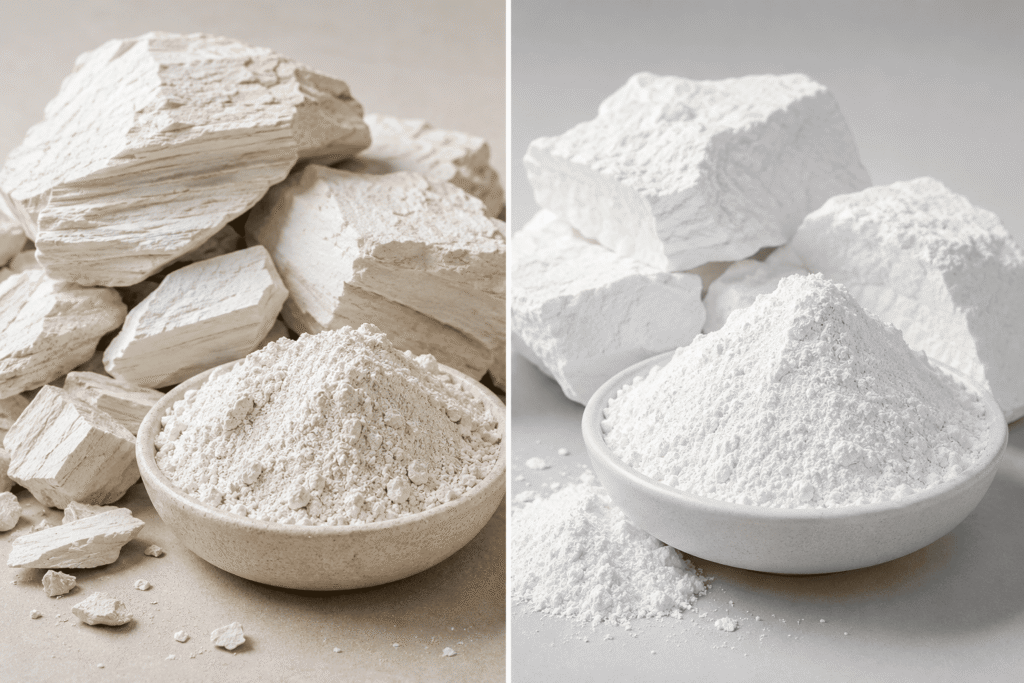
Kaolin is one of the most widely used industrial minerals across ceramics, paints, plastics, rubber, paper, and construction materials. However, many buyers and manufacturers often confuse natural kaolin clay with Calcined Kaolin because both originate from the same mineral source. The key difference lies in the processing method, physical properties, and industrial performance.
Understanding these differences is important for manufacturers looking to improve product quality, reduce production costs, and select the right raw material for specific applications.
What Is Kaolin Clay?
Kaolin clay, also known as china clay, is a naturally occurring soft white mineral primarily composed of hydrated aluminum silicate. It is valued for its fine particle size, chemical stability, and whiteness.
Natural kaolin is commonly used in:
- Ceramics and sanitaryware
- Paper coating
- Paints and coatings
- Rubber and plastics
- Cosmetic and personal care products
Because of its moisture content and layered crystal structure, raw kaolin has moderate brightness and limited thermal resistance compared to processed forms.
What Is Calcined Kaolin?
Calcined Kaolin is produced by heating natural kaolin clay at high temperatures, usually between 900°C and 1100°C. This controlled heating process removes chemically bound water and changes the mineral structure, resulting in a brighter, harder, and more performance-oriented material.
The final product, often sold as Calcined Kaolin Powder, offers improved opacity, enhanced whiteness, lower moisture absorption, and better electrical properties.
Industries prefer calcined grades when higher durability, superior finish, and enhanced chemical resistance are required.
How Is Calcined Kaolin Different from Natural Kaolin Clay?
Here are the major differences between the two materials:
|
Property |
Natural Kaolin Clay |
Calcined Kaolin |
|
Processing |
Raw and untreated |
Heat-treated at high temperature |
|
Moisture Content |
Higher |
Very low |
|
Brightness |
Moderate |
High brightness and whiteness |
|
Particle Structure |
Hydrated |
Dehydroxylated and harder |
|
Opacity |
Lower |
Higher |
|
Application Performance |
Standard |
Enhanced industrial performance |
Because of these upgraded characteristics, Calcined Kaolin Uses are far more extensive in premium industrial applications.
Common Calcined Kaolin Uses
Today, Calcined Kaolin Powder is widely used across several industries due to its improved functional properties.
Paints and Coatings:
Calcined kaolin improves opacity, scrub resistance, and brightness in decorative and industrial paints. It also helps reduce the need for expensive titanium dioxide.
Plastics and Polymers:
Manufacturers use calcined grades as reinforcing fillers to improve stiffness, dimensional stability, and surface finish.
Rubber Industry:
In rubber products, calcined kaolin enhances tensile strength, abrasion resistance, and durability.
Ceramics:
The ceramic industry uses calcined kaolin for improved firing performance, whiteness, and mechanical strength.
Paper Industry:
Calcined kaolin is used as a coating and filler material to improve printability and paper smoothness.
Why Industries Prefer Calcined Kaolin Powder
Manufacturers increasingly choose Calcined Kaolin Powder because it delivers:
- Better brightness and opacity
- Improved heat resistance
- Lower moisture absorption
- Enhanced dispersion
- Cost-effective performance in formulations
As demand rises in paints, plastics, and ceramics, businesses are also searching for reliable Calcined Kaolin Wholesaler partners that can provide consistent quality and bulk supply.
Factors Affecting Calcined Kaolin Prices
Several factors influence Calcined Kaolin Prices, including:
- Purity and whiteness level
- Particle size distribution
- Processing quality
- Bulk quantity requirements
- Packaging and logistics
Industrial buyers should compare technical specifications rather than selecting suppliers based only on price. High-quality calcined kaolin often delivers better long-term production efficiency and reduced formulation costs.
Where to Buy Calcined Kaolin
If you are looking to Buy Calcined Kaolin for industrial applications, choose a supplier that offers:
- Consistent product quality
- Reliable bulk supply
- Technical support
- Custom particle size options
- Competitive industrial pricing
Businesses sourcing from an experienced Calcined Kaolin Wholesaler can ensure stable performance across manufacturing operations. Contact us
Frequently Ask Questions
Kaolin clay is a natural hydrated mineral, while calcined kaolin is heat-treated to improve brightness, opacity, hardness, and industrial performance.
Calcined kaolin is mainly used in paints, plastics, rubber, ceramics, paper, and coatings industries.
It improves opacity, brightness, scrub resistance, and reduces titanium dioxide consumption.
For industrial applications requiring higher performance, calcined kaolin usually performs better due to its enhanced physical properties.
Prices depend on purity, whiteness, particle size, processing quality, and order quantity.
Yes, many industrial mineral suppliers and wholesalers offer bulk supply options for manufacturers.
The best wholesaler is one that provides consistent quality, reliable delivery, technical support, and competitive pricing.
Calcined kaolin is generally considered safe for industrial use when handled according to standard material safety guidelines.
Paints, ceramics, plastics, rubber, paper, and construction industries are major consumers.
You should evaluate brightness, particle size, opacity, and application-specific performance requirements before purchasing.