
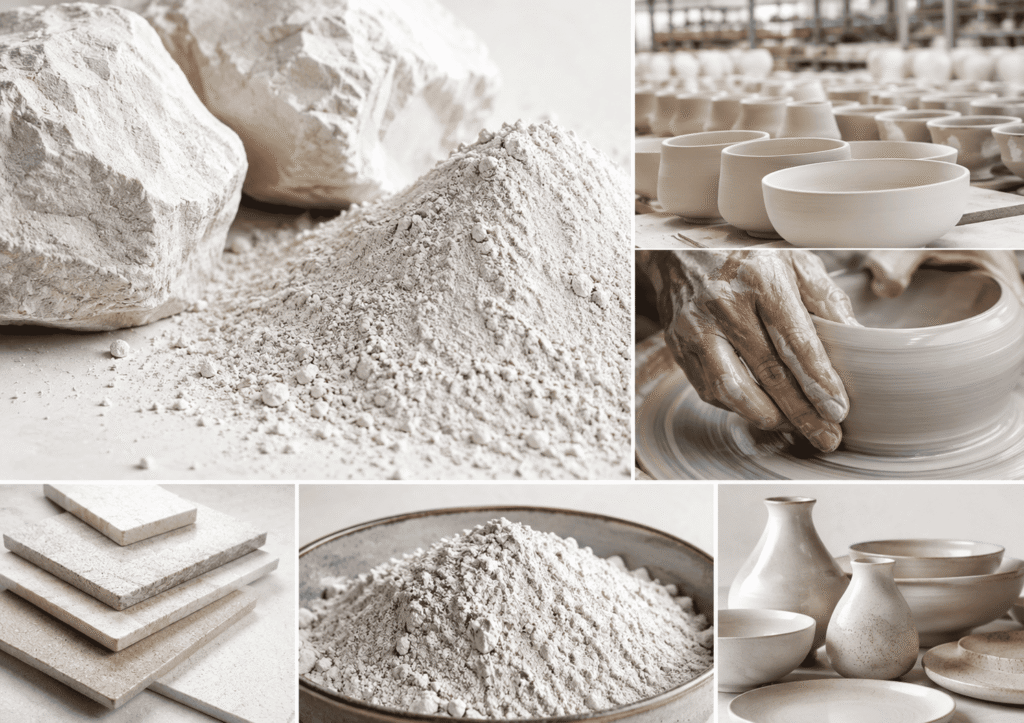
Ceramic manufacturing requires raw materials that deliver consistency, durability, and ease of processing. Among the most important minerals used in this industry is Ball Clay, a fine-grained sedimentary clay known for its exceptional plasticity and binding properties. Whether manufacturers are producing ceramic tiles, sanitary ware, tableware, porcelain, or electrical ceramics, Ball Clay Powder plays a vital role in achieving high-quality finished products.
As the demand for premium ceramic products continues to grow worldwide, manufacturers increasingly rely on a trusted Ball Clay Supplier to ensure consistent quality and uninterrupted production.
What Makes Ball Clay Ideal for Ceramic Manufacturing?
Unlike many other clay minerals, Ball Clay contains extremely fine particles that make it highly plastic when mixed with water. This allows ceramic manufacturers to shape complex products without cracking or losing structural integrity during forming.
Its excellent workability also enables automated production processes, making it suitable for both traditional and modern ceramic manufacturing techniques.
Some of the key properties that make Ball Clay valuable include:
- High plasticity for easy shaping
- Excellent green strength before firing
- Fine particle size for smooth surface finish
- Superior binding characteristics
- Consistent firing performance
- Improved mechanical strength of finished ceramics
These characteristics help ceramic manufacturers maintain uniform product quality while reducing production defects.
Technical Advantages
From a technical perspective, Ball Clay offers an ideal balance of mineral composition and physical properties that enhance ceramic body performance throughout the manufacturing process. Its fine particle size improves particle packing, resulting in better density and reduced porosity in finished ceramic products. Ball Clay Powder also contributes to improved dry strength, allowing ceramic components to withstand handling before firing with minimal damage. During firing, it works effectively with other raw materials such as feldspar, silica, and kaolin to achieve controlled shrinkage, dimensional stability, and consistent vitrification.
These technical advantages help manufacturers produce ceramic tiles, sanitary ware, porcelain, and tableware with superior strength, smooth surface finish, and long-term durability. For consistent production results, sourcing from an experienced Ball Clay Supplier, Ball Clay Manufacturer, and Ball Clay Exporter ensures reliable quality and dependable performance across every batch.
How Ball Clay Improves Ceramic Production
1. Enhances Plasticity
One of the primary reasons manufacturers use Ball Clay Powder is its ability to improve plasticity. During moulding or extrusion, ceramic bodies become easier to shape into intricate designs while maintaining dimensional stability.
Higher plasticity also reduces material wastage during production.
2. Provides Better Green Strength
Before ceramic products enter the kiln, they must withstand handling, drying, and transportation within the manufacturing plant.
Ball Clay increases green strength, reducing the chances of breakage before firing. This results in improved production efficiency and lower rejection rates.
3. Improves Surface Finish
The ultra-fine particle size of Ball Clay creates smoother ceramic surfaces. Manufacturers benefit from:
- Better glaze adhesion
- Uniform texture
- Reduced surface imperfections
- Improved aesthetic appearance
These advantages are especially important for premium ceramic tiles, sanitary ware, and porcelain products.
4. Supports Consistent Firing Results
Consistency during kiln firing is critical in ceramic manufacturing. A high-quality Ball Clay Manufacturer supplies material with controlled mineral composition, helping manufacturers achieve predictable shrinkage, strength, and color after firing.
This consistency minimizes production variations and improves overall product reliability.
Applications of Ball Clay in the Ceramic Industry
Because of its versatile properties, Ball Clay Powder is widely used across various ceramic segments, including:
- Ceramic floor and wall tiles
- Porcelain products
- Sanitary ware
- Tableware
- Decorative ceramics
- Electrical porcelain insulators
- Ceramic art and pottery
Manufacturers often blend Ball Clay with kaolin, feldspar, silica, and quartz to create ceramic bodies that meet specific performance requirements.
Choosing the Right Ball Clay Supplier
Not all raw materials deliver the same level of performance. Selecting an experienced Ball Clay Supplier ensures consistent mineral quality, reliable particle size distribution, and dependable supply for large-scale manufacturing.
When evaluating suppliers, consider:
- Product consistency
- Quality control processes
- Mineral purity
- Export capability
- Timely delivery
- Technical expertise
Working with an established Ball Clay Exporter also ensures that international ceramic manufacturers receive high-quality material that complies with global industry standards.
Why Manufacturers Trust Experienced Ball Clay Exporters
Global ceramic manufacturers require dependable sourcing partners that can maintain quality across every shipment. A professional Ball Clay Manufacturer invests in advanced processing, testing, and packaging systems to ensure the clay performs consistently in demanding ceramic applications.
An experienced Ball Clay Exporter also understands international logistics, documentation, and quality requirements, making global procurement more efficient and reliable.
Conclusion
The growing ceramic industry depends on raw materials that deliver superior performance, consistency, and production efficiency. Ball Clay remains one of the most valuable materials because of its excellent plasticity, binding ability, smooth finish, and strength-enhancing properties.
Whether manufacturing ceramic tiles, sanitary ware, porcelain, or specialty ceramics, using premium Ball Clay Powder from a reliable Ball Clay Supplier, Ball Clay Manufacturer, and Ball Clay Exporter helps improve product quality while supporting efficient, cost-effective production.
Frequently Ask Questions
Ball Clay is mainly used to improve plasticity, workability, green strength, and surface finish in ceramic products.
It enhances shaping, reduces cracking, and improves the strength and finish of ceramic tiles.
Ball Clay offers higher plasticity and binding properties, while kaolin provides whiteness and refractoriness. They are often used together in ceramic formulations.
Ball Clay Powder is widely used in ceramic tiles, sanitary ware, porcelain, tableware, pottery, and electrical ceramics.
Its fine particles and binding ability help ceramic bodies remain strong before firing, reducing handling damage.
Choose a supplier offering consistent quality, controlled particle size, high purity, reliable supply, and technical support.
Yes. Ball Clay is commonly blended with kaolin, feldspar, and silica to manufacture high-quality porcelain products.
Processed Ball Clay Powder provides uniform particle size, better consistency, and improved manufacturing performance.
Yes. Experienced Ball Clay Exporters provide quality-tested materials and handle international shipping and export documentation.
It reduces material wastage, minimizes defects, improves shaping, and supports consistent firing results, leading to higher manufacturing efficiency.