Clay minerals are widely used across industries ranging from ceramics and cosmetics to pharmaceuticals and construction. Among the most commonly used industrial clays are kaolin clay and bentonite clay. Although both materials belong to the clay mineral family, they differ significantly in composition, texture, absorption capacity, and industrial applications.
Understanding the difference between these two minerals helps manufacturers choose the right material for their production requirements. In this guide, we compare Kaolin Clay and bentonite clay based on their properties, uses, and industrial performance.
What Is Kaolin Clay?
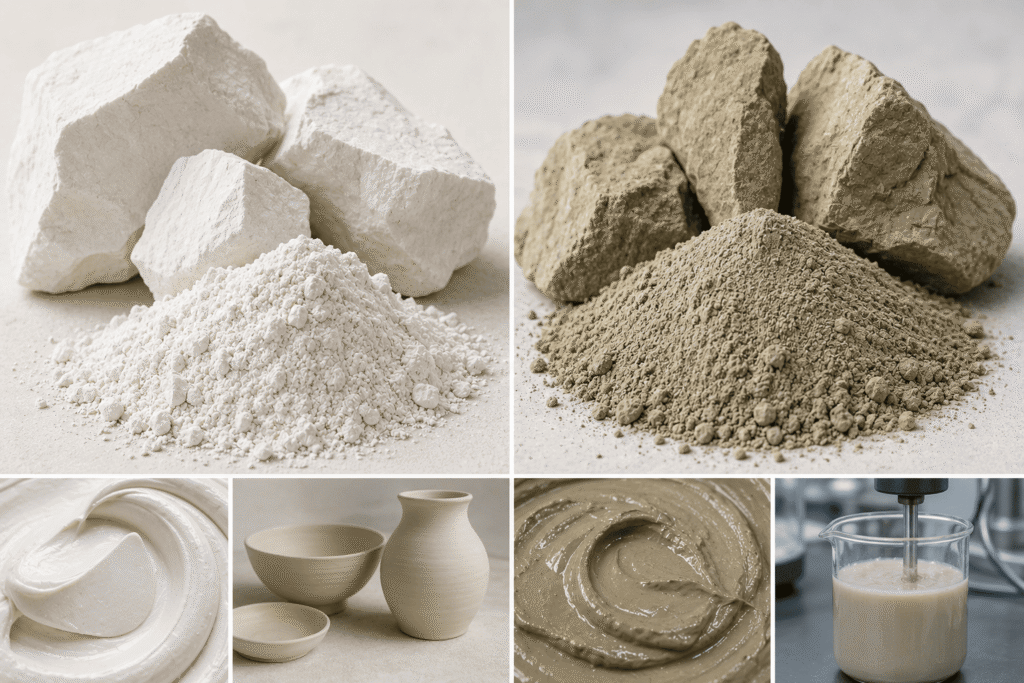
Kaolin clay is a naturally occurring soft white clay primarily composed of the mineral kaolinite. Known for its fine particle size and bright white appearance, White Kaolin Clay is widely used in ceramics, paper, paints, rubber, cosmetics, and industrial coatings.
Industries prefer Kaolin Clay Powder because it offers excellent chemical stability, smooth texture, and low shrinkage properties. It is especially valued in applications that require whiteness, purity, and fine consistency.
What Is Bentonite Clay?
Bentonite clay is mainly composed of montmorillonite minerals and is known for its strong water absorption and swelling capabilities. Unlike kaolin, bentonite expands significantly when mixed with water, making it highly useful in drilling fluids, sealants, absorbents, and environmental applications.
Its high adsorption capacity allows it to bind impurities effectively, which is why bentonite is commonly used in industrial filtration and sealing systems.
Kaolin Clay vs Bentonite Clay: Key Differences
1. Composition
Kaolin Clay primarily contains kaolinite minerals, while bentonite contains montmorillonite. This difference in mineral composition directly affects their physical and industrial properties.
Kaolin is chemically stable and less reactive, whereas bentonite has strong swelling and absorption characteristics.
2. Color and Texture
White Kaolin Clay is generally bright white and has a soft, smooth texture. Bentonite clay is usually gray, green, or cream-colored and becomes sticky when wet.
This makes kaolin more suitable for products requiring a clean appearance and fine finish.
3. Absorption Capacity
One of the biggest differences lies in water absorption. Bentonite absorbs large amounts of water and expands significantly, while kaolin has lower absorption and maintains structural stability.
Because of this, bentonite is commonly used in absorbent and sealing applications, while kaolin is preferred in ceramics and coatings.
4. Industrial Applications
The industrial uses of both clays vary significantly.
Common Kaolin Uses:
- Ceramic manufacturing
- Paper coating
- Paints and coatings
- Rubber and plastics
- Cosmetics and skincare products
- Porcelain and sanitaryware
Common Bentonite Uses:
- Drilling mud
- Cat litter
- Waterproofing systems
- Industrial absorbents
- Foundry sands
- Environmental sealing
Why Industries Prefer Kaolin Clay
Manufacturers choose Kaolin Clay Powder because of its purity, brightness, fine particle size, and thermal stability. It improves product quality while maintaining smooth textures and strong mechanical properties.
Industries looking to Buy Kaolin Clay often prioritize consistency, whiteness, and controlled particle distribution for industrial production.
The growing demand for Kaolin Clay for Sale is driven by expanding ceramic, paper, paint, and cosmetic industries worldwide.
Choosing the Right Clay for Industrial Applications
The selection between kaolin and bentonite depends entirely on the intended application.
If your industry requires:
- High whiteness
- Fine texture
- Low shrinkage
- Better surface finish
then White Kaolin Clay is usually the better option.
However, if the application needs:
- High water absorption
- Swelling capacity
- Sealing performance
Then bentonite clay may be more suitable.
Conclusion
Both kaolin clay and bentonite clay offer unique industrial advantages. While bentonite is known for its absorption and swelling capabilities, Kaolin Clay is preferred for applications requiring purity, brightness, smoothness, and thermal stability.
From ceramics and paints to paper and cosmetics, the demand for premium-quality Kaolin Clay Powder continues to grow across industries. Businesses planning to Buy Kaolin Clay should always source materials from trusted suppliers offering consistent quality and reliable supply capabilities.
Frequently Ask Questions
Kaolin clay has low absorption and high whiteness, while bentonite clay has strong swelling and water absorption properties.
Kaolin is used in ceramics, paper, paints, rubber, plastics, cosmetics, and porcelain manufacturing.
White kaolin clay improves brightness, surface finish, strength, and firing stability in ceramic products.
Both clays serve different purposes. Kaolin is better for ceramics and coatings, while bentonite is preferred for absorbent and sealing applications.
You can buy kaolin clay from trusted industrial mineral suppliers and manufacturers offering high-purity grades.
Kaolin clay powder is widely used in paper coating, ceramics, paints, cosmetics, and rubber manufacturing.
Kaolin improves paint smoothness, durability, opacity, and surface finish.
Yes, bentonite clay has a much higher water absorption and swelling capacity than kaolin clay.
Ceramics, paper, paint, cosmetic, rubber, and construction industries are major users of kaolin clay.
Choose suppliers based on purity, particle size consistency, product quality, and reliable supply capability.